Tel/WhatsAapp:+86 18011919834
E-mail: chloe.x@fybagcustom.com

Tel/WhatsAapp:+86 18011919834
E-mail: chloe.x@fybagcustom.com
Send Your Inquiry Today

A logo on a bag is more than decoration. It is the single visual element that transforms a commodity product into a branded asset. For brand owners, importers, and e-commerce sellers sourcing custom bags from manufacturers, the difference between a forgettable logo application and a compelling one can determine sell-through rates, customer loyalty, and overall brand equity.
Yet many B2B buyers treat logo design as an afterthought—uploading a flat vector file, picking the cheapest print method, and moving on. The result is a bag that looks like every other product on the shelf, in the warehouse, or in the unboxing video. That is a missed opportunity with real financial consequences.
This guide breaks down seven design principles that separate high-performing branded bags from generic ones. Each tip addresses both the creative and manufacturing dimensions, because in the custom bag industry, what looks great on a screen must also survive production, shipping, and daily use.
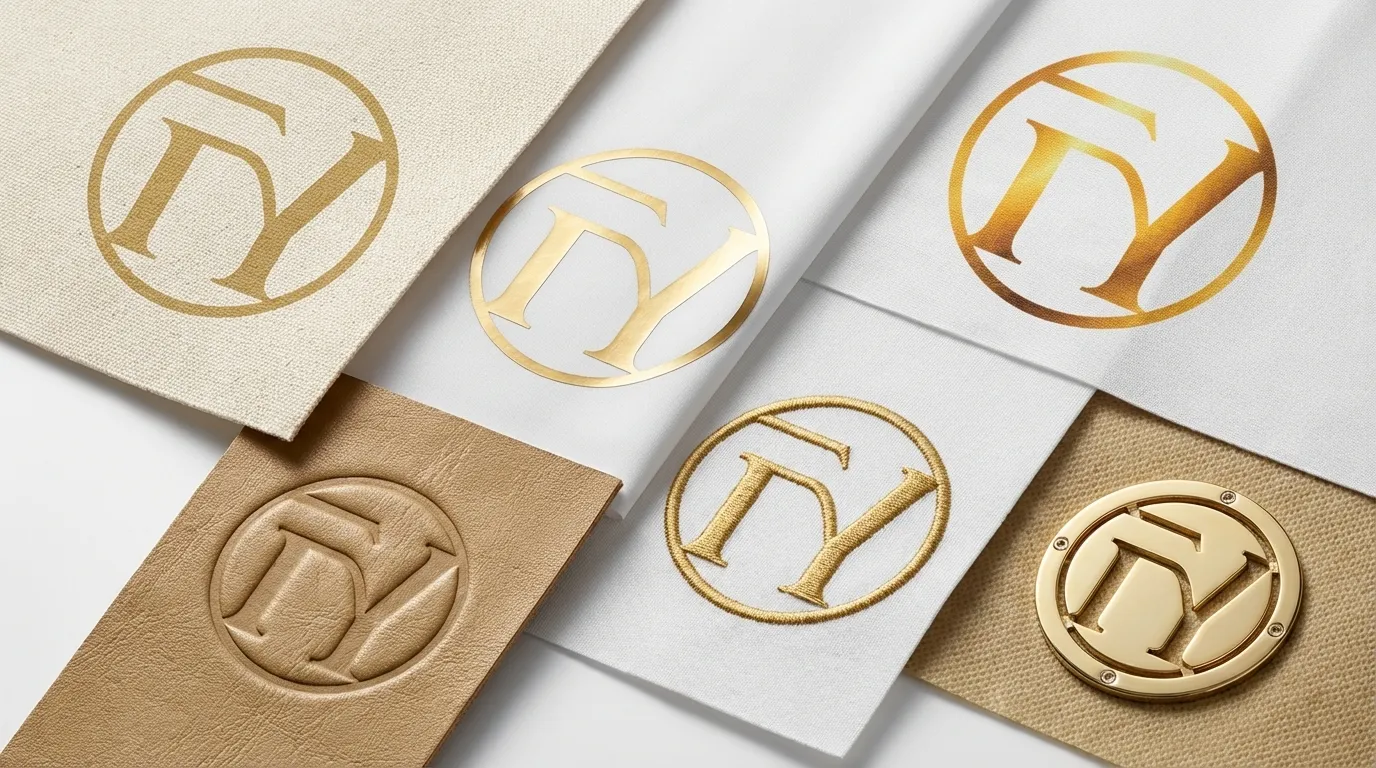
The most common mistake in custom bag branding is designing a logo in isolation—on a white digital canvas—without considering what it will look like on the actual material surface. A logo that pops on a Photoshop mockup can fall flat on ripstop nylon, disappear into textured canvas, or bleed on uncoated polyester.
Every bag material has a distinct surface texture, absorbency, and color behavior. These properties directly affect how inks, threads, and hardware interact with the substrate.
Before finalizing any logo artwork, request material swatches from your manufacturer. Ask for a test print or sample application on the actual material you plan to use. At fybagcustom, sampling includes logo application testing so that buyers can evaluate real-world rendering before committing to bulk production.
| Material | Screen Print | Heat Transfer | Sublimation | Embroidery | Deboss / Emboss | Foil Stamp |
|---|---|---|---|---|---|---|
| Nylon | ★★★★ | ★★★★ | ✗ | ★★★ | ✗ | ★★ |
| Polyester (light) | ★★★ | ★★★★ | ★★★★★ | ★★★ | ✗ | ★★ |
| Canvas | ★★★★★ | ★★★ | ✗ | ★★★★★ | ★★ | ★★ |
| PU / Vegan Leather | ★★ | ★★★★ | ✗ | ★★ | ★★★★ | ★★★★★ |
| Genuine Leather | ✗ | ★★ | ✗ | ★★ | ★★★★★ | ★★★★★ |
(★★★★★ = excellent compatibility; ✗ = not recommended)
Many B2B buyers default to screen printing because it is familiar and cost-effective at scale. But the application method is itself a design decision. Each technique produces a fundamentally different aesthetic, tactile quality, and durability profile.
Screen PrintingBest for bold, flat-color designs with clean edges. Economical for orders above 300–500 units. Limited to roughly 4–6 colors per design (each color requires a separate screen). Not ideal for photographic images or fine gradients.
Heat Transfer (DTF / Vinyl)Supports full-color, photographic-quality artwork. Works on most materials. Lower setup cost than screen printing, making it viable for smaller runs. However, the transfer patch can feel plasticky on some materials and may crack or peel after extended use if quality is not controlled.
Sublimation PrintingProduces vibrant, all-over prints that are permanently bonded into polyester fibers. The result feels like the design is part of the fabric, not sitting on top of it. Limited to polyester and polyester-coated substrates. Cannot print white—the fabric color shows through.
EmbroideryAdds texture and a premium perceived value. Extremely durable. Best for simple logos with limited color variation (typically 6–8 thread colors max). Not suitable for very small text or fine-line illustrations. Thread density and backing type matter for quality control.
Debossing / EmbossingCreates a subtle, tactile impression in leather, PU, or heavy canvas. Communicates luxury and restraint. No ink or thread involved—the logo is pressed into the material itself. Best for monochromatic logos and wordmarks. Detail is limited by material thickness and press pressure.
Metal Hardware / Branded ZippersOften overlooked, custom zipper pulls, rivets, snap buttons, and metal logo plates can elevate a bag’s brand presence. These elements add production cost and lead time but create a multi-sensory brand experience.
| Decision Factor | Screen Print | Heat Transfer | Sublimation | Embroidery | Deboss / Emboss |
|---|---|---|---|---|---|
| Color complexity | Low–Medium | High | Very High | Low | Monochrome |
| Minimum order viability | 300+ pcs | 50+ pcs | 100+ pcs | 100+ pcs | 200+ pcs |
| Perceived value | Standard | Standard–High | High | Premium | Premium |
| Durability | ★★★ | ★★★ | ★★★★★ | ★★★★★ | ★★★★★ |
| Setup cost | Medium | Low | Medium | Medium–High | High (custom die) |
| Texture / tactile quality | Flat | Slight film | Smooth (integrated) | Raised / textured | Indented / raised |
| Best for | Promo bags, totes | Full-color designs | All-over print bags | Corporate, premium | Leather goods, luxury |
When working with a manufacturer like fybagcustom, it is standard practice to discuss two or three application methods during the sampling phase. Buyers who test multiple methods on the same bag design almost always choose a different option than their initial assumption.
Where a logo sits on a bag is just as important as how it is rendered. Placement governs visibility, balance, and brand impression. A logo that is too large feels cheap. One that is too small gets lost. One that is placed without regard to the bag’s structural lines looks careless.
Front Panel Center: The most common placement. High visibility but also the most expected. Works well for tote bags, backpack flap covers, and duffel bags. Risk of appearing generic if the design itself is not distinctive.
Lower Right / Lower Left Corner: Creates a subtler, more refined impression. Common in premium and lifestyle segments. Suggests confidence—the brand does not need to shout. Works particularly well with embroidery and debossing.
Zipper Pull or Hardware: A secondary brand touchpoint that adds perceived value without dominating the visual. Particularly effective for bags targeting retail and direct-to-consumer channels.
Interior Lining or Interior Label: An “insider” branding moment that enhances the unboxing experience. Increasingly important for e-commerce brands where the first physical interaction is the customer opening the package.
All-Over Repeat Pattern: The entire bag surface becomes the brand expression. Requires sublimation or full-panel screen printing. Most effective when the pattern is proprietary and recognizable at a distance. Widely used in fashion and lifestyle segments.
A useful rule for standard bag logo placement: the logo should occupy approximately 15–25% of the face panel’s visible area for a confident, balanced look. Below 10%, the logo risks being missed. Above 40%, it begins to feel like a promotional giveaway rather than a branded product.
These are guidelines, not rules. The right scale depends on the bag’s intended market position. A corporate gift bag might use a smaller, more restrained logo. A festival giveaway tote might intentionally go bold and oversized.
Color is the fastest communicator of brand identity. Research consistently shows that consumers associate specific colors with specific brand attributes: blue conveys trust, black signals premium positioning, green suggests sustainability, and so on. But in custom bag production, color decisions have practical manufacturing implications beyond psychology.
Every additional color in a screen-printed or embroidered logo adds production cost, extends lead time, and increases the risk of registration errors (misalignment between color layers). A two-color logo that is bold and well-designed will almost always outperform a six-color logo that is visually cluttered.
| Market Segment | Recommended Palette | Reasoning |
|---|---|---|
| Corporate / B2B gifting | 1–2 colors (often monochrome) | Clean, professional, cost-efficient |
| Fashion / lifestyle | 2–3 colors or tonal (same family) | Distinctive without being loud |
| Outdoor / adventure | High-contrast 2–3 colors | Visibility and ruggedness |
| Eco / sustainable | Earth tones, 1–2 colors | Aligns with material aesthetics |
| Promo / event giveaway | Bold, high-contrast, 1–2 colors | Maximum impact at lowest unit cost |
Many brands have one logo file that they apply everywhere. On a website header, it might work fine. On a bag zipper pull, it becomes an illegible blob. On a full-panel tote, it looks stretched and awkward.
Professional brands operate with a logo system—a family of related marks designed to work across different scales, materials, and applications.
Primary Logo (Lockup): The full logo with wordmark, icon, and tagline. Used on packaging, hangtags, and large-format applications where space is generous.
Secondary Logo (Simplified): The logo without the tagline, or with a rearranged layout (e.g., stacked instead of horizontal). Used when the primary logo does not fit the available space or aspect ratio.
Icon / Monogram / Brandmark: A simplified, standalone symbol that is recognizable at very small sizes. This is what goes on zipper pulls, snap buttons, interior labels, and small embroidery placements. If your brand does not have a standalone icon, you are limiting your hardware branding options.
Pattern Mark: An optional repeating motif derived from the logo or brand visual identity. Used for lining prints, all-over sublimation, and tissue paper in packaging. Creates brand recognition even without the logo itself.
When you provide a manufacturer with a logo system rather than a single file, they can recommend the optimal mark for each application point on the bag. This eliminates the common problem of forcing a complex horizontal logo onto a small, vertical space—which always results in a compromise.
At fybagcustom, the design team regularly works with buyers to adapt logo systems for different bag components. If a brand only has a single logo, the factory’s designers can propose simplified versions for hardware and interior applications during the product development phase.
The most memorable custom bags in the market do not rely solely on a logo. They use the entire bag as a branding surface—through coordinated color, material choice, trim details, lining, packaging, and labeling. The logo is one element in a larger visual ecosystem.
Custom Lining: A branded or patterned interior lining transforms the user experience. Every time the bag is opened, the brand is reinforced. Sublimation-printed polyester lining is cost-effective and durable.
Branded Zipper Tape: The strip of fabric on either side of the zipper teeth. Custom-colored or printed zipper tape is a subtle detail that communicates attention to quality.
Custom Hang Tags and Care Labels: These are the first things a retail buyer or end consumer sees. Invest in quality cardstock, branded design, and clear care instructions. They also serve compliance purposes for many markets.
Custom Packaging (Poly Bags, Dust Bags, Boxes): For premium bags, a branded dust bag or printed poly bag elevates the unboxing experience. For Amazon FBA sellers, packaging that photographs well supports product listing quality.
Accent Colors and Trim: Contrast stitching, colored binding tape, and tonal zippers add design interest without requiring additional printing. These are structural choices made during the product development phase.
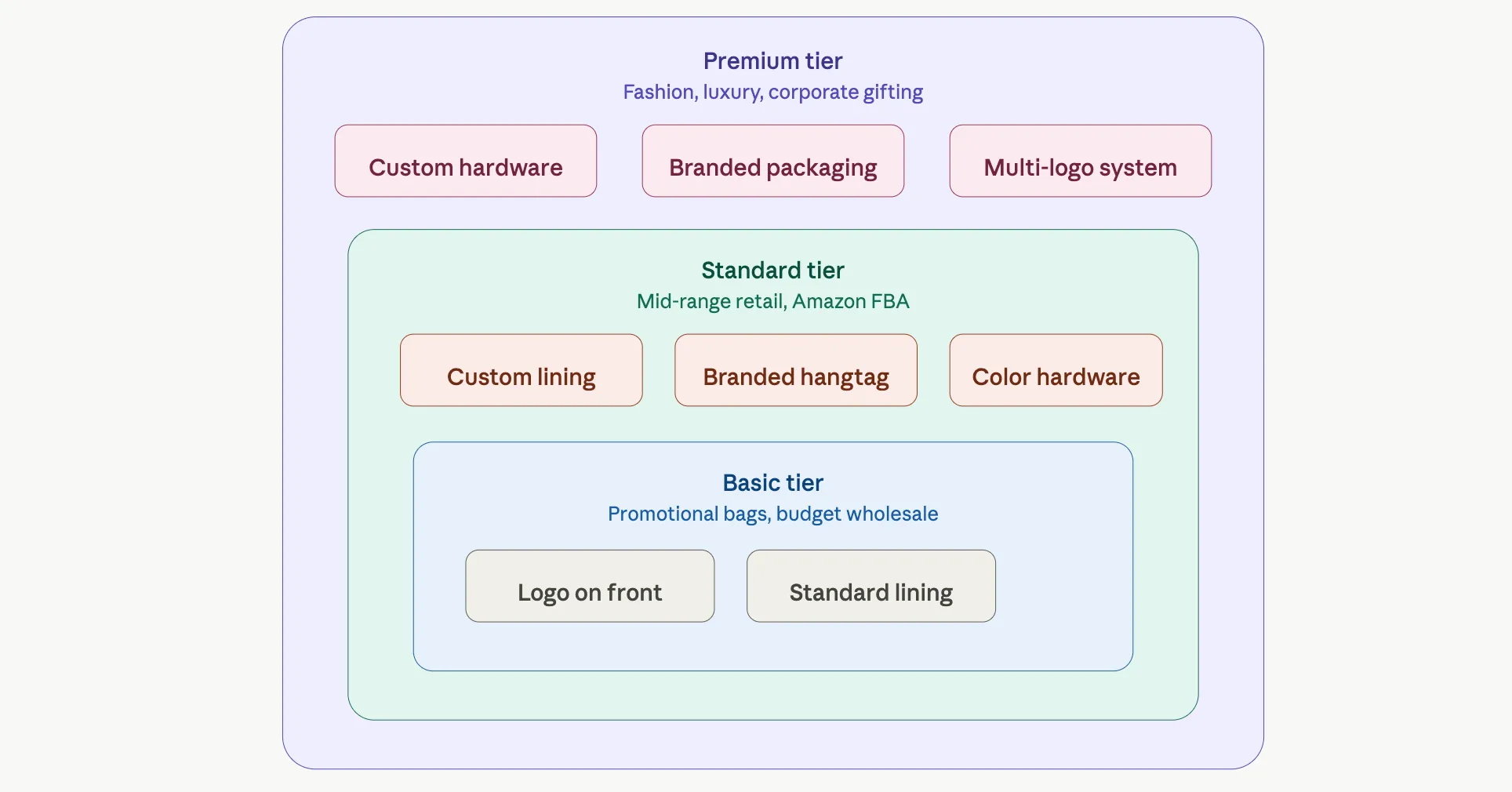
Not every bag project warrants maximum brand surface treatment. The right level of investment depends on the product’s price point, distribution channel, and target buyer.
| Investment Level | What’s Included | Best For |
|---|---|---|
| Basic | Logo on front panel + standard lining + generic hangtag | Promotional bags, budget wholesale |
| Standard | Logo + custom lining + branded hangtag + color-matched hardware | Mid-range retail, Amazon FBA |
| Premium | Logo system across multiple touchpoints + custom lining + branded packaging + custom hardware | Fashion brands, corporate gifting, luxury positioning |
The final and arguably most important design tip is one that many buyers skip under time pressure: prototyping the logo application before committing to a full production order.
Digital mockups, no matter how sophisticated, cannot replicate how a logo will look and feel on a physical bag. Thread tension in embroidery, ink absorption on fabric, foil adhesion on leather, registration accuracy in multi-color screen printing—all of these variables only reveal themselves in a physical sample.
A well-structured sampling workflow typically follows this sequence:
At fybagcustom, this process typically takes 7–15 days from concept to approved sample, depending on complexity. The investment in sampling pays for itself many times over by eliminating costly corrections during bulk production.
Designing a logo for a custom bag is not a graphic design task—it is a manufacturing decision, a branding strategy, and a quality control checkpoint rolled into one. The seven principles above can be summarized as follows:
For brand owners and sourcing professionals evaluating custom bag manufacturers, the depth of a factory’s design and sampling support is a reliable indicator of their overall capability. A manufacturer that proactively advises on logo compatibility, offers multiple application methods, and invests in rigorous pre-production sampling is a partner that will protect your brand in the long run.
fybagcustom works with brands at every stage of this process—from initial logo adaptation through material testing, multi-method sampling, and full production. Whether you are launching a new bag line, refreshing an existing product, or exploring private-label opportunities, the conversation starts with how your brand will show up on the finished product.
FYBagCustom’s OEM and ODM team works with global brands, Amazon sellers, wholesalers, and corporate programs to translate brand vision into production-quality custom bags — with low MOQ, 7-day sampling, and full decoration support from emboss to embroidery.
Start Your Custom Bag Project →