Tel/WhatsAapp:+86 18011919834
E-mail: chloe.x@fybagcustom.com

Tel/WhatsAapp:+86 18011919834
E-mail: chloe.x@fybagcustom.com
Send Your Inquiry Today

of Orders Involve Printing
Print Methods In-House
Repeat Accuracy Rate
Artwork Review & Proof
Each method produces a different visual result, works on different fabrics, and operates at different cost/volume breakpoints. Understanding the trade-offs is the first step to choosing the right method for your project.
| Method | Best For | Strengths | Limitations | Cost Profile |
|---|---|---|---|---|
| Screen Print | Canvas/cotton totes, nylon bags, promo shoppers | Solid opaque coverage, high durability, most cost-efficient at volume (500+ pcs) | 1–4 colors max, not for photo gradients or micro detail | Screen fee per color; lowest unit cost at volume |
| Digital Print | Small/medium runs with multi-color, gradient, or photographic artwork | Full CMYK, photo-realistic, fast artwork iteration, no screen setup | Higher unit cost than screen at volume; best under 500 pcs | Low setup; higher per-unit; ideal for pilot runs and FBA small batches |
| Heat Transfer | Nylon/polyester where durability and flexibility matter | Bright color, good detail, versatile on synthetics, reflective option for sports | Large full-bleed areas can stiffen fabric; transfer film adds slight thickness | Mid-range; flexible MOQ; transfer film digitally printed externally |
| UV Print | PU leather panels, gift boxes, TPU/PVC windows, hard surfaces | Instant cure, spot-gloss/texture effects, sharp fine text, white ink base for dark substrates | Substrate must be flat and ink-receptive; not for stretch or heavily textured fabrics | Low setup; ideal for premium finishes and small-panel applications |
| Sublimation | All-over prints on polyester/PU-coated poly | Highest colorfastness, zero hand-feel change (ink bonds INTO fiber), seamless all-over coverage | ONLY works on polyester or poly-coated fabrics; not for cotton/leather/jute | Mid-range setup; good from 300+ pcs for all-over poly bags |
| Lamination | Full-surface CMYK on non-woven PP | Full-surface photographic print on shopping/promo bags; BOPP film adds gloss + water resistance | Only for non-woven PP bags; print plate setup fee for first run | Plate fee; lowest unit cost for full-color non-woven at volume (1,000+ pcs) |
Print Stations
Print Applications per Day
Days for Strike-Off Proof on Fabric
Printed Graphics
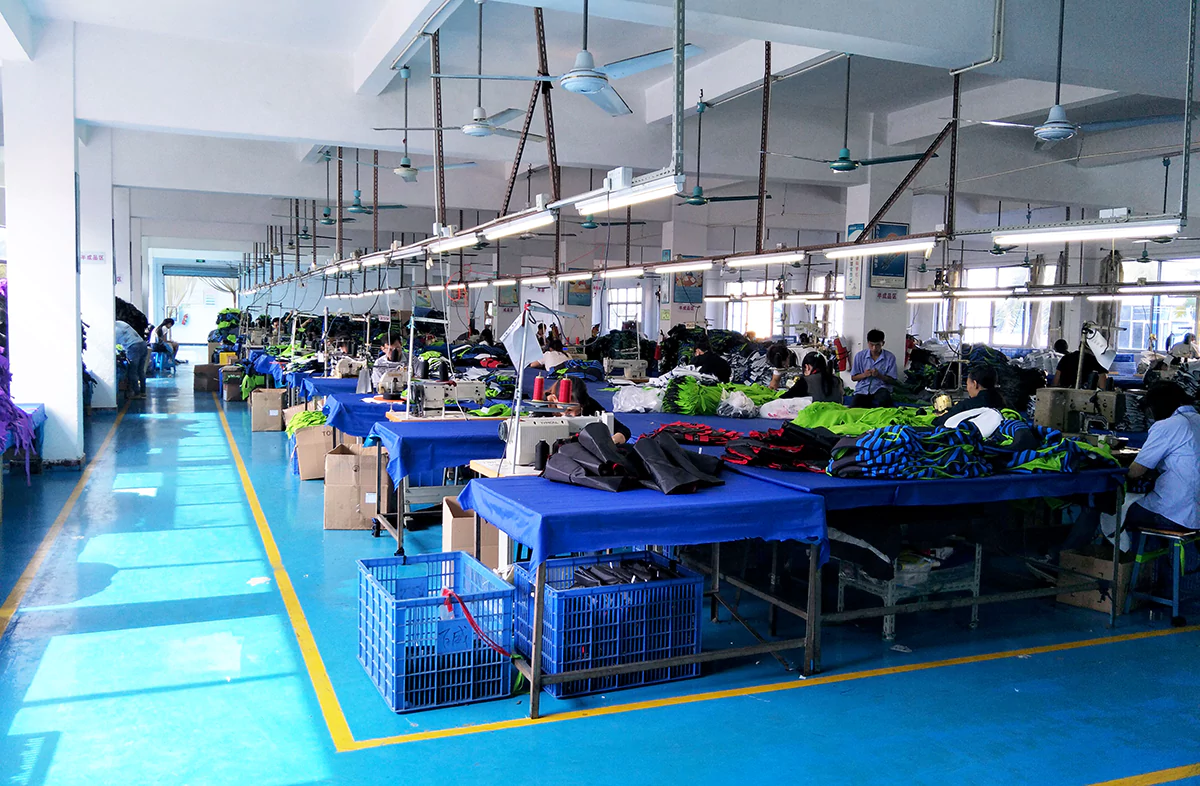
Why in-house printing matters: Graphic printing runs on the same production floor as cutting and sewing. The panel goes from cutting → printing → sewing in one continuous flow. If a print issue is detected at the print station, it’s caught and corrected BEFORE the panel is sewn into a bag. External print shops add 3–5 days, a shipping step, and a quality-control blind spot between printing and assembly.
Different surfaces absorb ink, bond adhesives, and flex under stress very differently. The substrate is the #1 filter that eliminates incompatible methods before you consider anything else.
PU Leather → UV, deboss, foil, heat transfer
Canvas / Cotton → screen, digital (DTG/DTF), embroidery
Nylon / Poly → heat transfer, sublimation (poly), screen
Non-Woven PP → screen, lamination (BOPP)
Your desired vibe should steer the method — even when several methods are technically compatible with your fabric.
Sport / outdoor durability → heat transfer, reflective transfer, rubber patch
Sport / outdoor durability → heat transfer, reflective transfer, rubber patch
The artwork itself dictates feasibility. Some methods handle photographic gradients beautifully; others only work with bold solid shapes.
Large solid areas / bold logos → screen (most opaque and durable)
All-over full-surface → sublimation (poly), transfer, lamination (non-woven)
There’s no “best method” without knowing your volume and budget. Match printing economics to your business case.
50–500 pcs → digital, UV (low/no setup cost; higher per-unit)
300–2,000 pcs → heat transfer, sublimation (mid-volume sweet spot)
500+ pcs → screen (setup cost amortized; lowest unit cost)
1,000+ pcs → lamination (plate cost amortized; full-surface CMYK non-woven)
Not sure which method fits? Send your artwork + fabric + volume — we’ll recommend Route A (cost-efficient) and Route B (premium finish) so you can decide fast.
Getting the file right saves days of back-and-forth. Here’s what we need for each print method — and what we fix for free if your file isn’t production-ready.
| Method | File Format | Resolution | Color Mode | Key Notes |
|---|---|---|---|---|
| Screen | AI, PDF (vector) | Vector (scalable) | Pantone spot | Max 4 colors. Each color = 1 screen. Separate color layers. |
| Heat Transfer | AI, PDF, TIFF | 300 DPI at size | CMYK | Include 3mm bleed. Mirror artwork for application. |
| Digital | TIFF, PSD, AI | 300 DPI at size | CMYK | Best for complex/photographic. No screen setup. |
| UV | AI, PDF, TIFF | 300 DPI | CMYK + White | White ink base for dark substrates. Spot-gloss layers separate. |
| Sublimation | TIFF, PSD, AI | 300 DPI at size | CMYK | Mirror artwork. Polyester/poly-coat only. Include bleed for all-over. |
| Lamination | AI, PDF, TIFF | 300 DPI | CMYK | All-over on non-woven. Include bag dieline for panel alignment. |
Not sure about your file? Send what you have — we review every artwork file for free and tell you what needs adjustment before proofing. We fix minor issues (resolution upscaling, color-mode conversion, bleed extension, layer separation) in-house at no charge.
Surface graphics are the most visible element on a printed bag — any color shift, registration error, or pattern misalignment is immediately noticeable. Our 3-stage proofing process catches problems before they become 5,000 defective bags.

Your artwork placed on the actual bag template — showing exact placement, scale, and color on each panel. For all-over prints: seam placement preview showing where the pattern breaks across construction lines. You approve the layout before any ink touches fabric. Revisions at this stage are free and fast.

A physical print sample on the ACTUAL fabric — not paper, not screen. You see the real colors, coverage, hand-feel, and adhesion on the production material. Pantone-verified under D65 lighting. You approve before bulk printing begins. This step catches 90% of color and adhesion issues before they reach the production line.

During bulk printing: color consistency checked against the approved strike-off every 100 pcs. Pattern registration verified (alignment across panels and at seam junctions). Bleeding, gaps, smearing, and coverage defects flagged and corrected immediately. The approved strike-off is pinned at the print station as the LIVE reference throughout the entire run.
Printing adds $0.10–$3.00+ per bag depending on the method, coverage area, and volume. This table helps you match the right method to your budget tier.
| Method | Cost / Unit | Setup Cost | Sweet-Spot Volume | Best Application |
|---|---|---|---|---|
| Screen Print | $0.10–$0.50 | Screen fee / color | 500+ pcs | Solid logos, promo bags, large bold graphics |
| Digital | $0.50–$2.00 | Low / none | 50–500 pcs | Photographic, collabs, FBA small batches |
| UV Print | $0.30–$1.50 | Low / none | 50–1,000 pcs | PU leather panels, spot-gloss, packaging |
| Heat Transfer | $0.15–$0.60 | Low (digital film) | 300–2,000 pcs | Multi-color on synthetics, sports bags |
| Sublimation | $0.30–$1.00 | Transfer paper setup | 300+ pcs | All-over polyester bags |
| Lamination | $0.15–$0.40 | Print plate fee | 1,000+ pcs | Full-color non-woven shopping bags |
Reorder savings: Screen fees and plate fees are one-time. If your graphic doesn’t change between reorders, you pay only the per-unit print cost on subsequent orders. Sublimation transfer paper is reprinted each time but at low cost. Digital and UV have no setup cost on any order.
We’ll reply with Route A/Route B recommendations, color-management plan, and a sampling timeline so you can launch faster with confidence.
At FY Bag Factory, we turn your creative concepts into market-ready products. Simply share your sketches, mood boards, or brand guidelines, and our professional design team will translate them into technical drawings, prototypes, and final production samples. As a full-service OEM/ODM bag factory, we manage everything—from material sourcing and color matching to logo application, quality testing, and FBA- or retail-ready packing.With stable production capacity, strict QC, and more than 500 global brands served, we ensure every order is delivered consistently and on time.
What you will get:
A structured intake confirming specs, constraints, and success criteria so we can protect your margins and timelines.
We evaluate your project through the Four Levers (Substrate / Look & Feel / Detail Level / Order Profile) and propose 1–2 viable routes:
Each route includes:
you will get a route that fits brand aesthetics and economics.
To keep reorders and multi-SKU lines consistent:
fewer surprises, photo-ready samples, and consistent color across collections.

We build a PP sample on the exact materials and finishes:
Deliverables: the PP sample, photos/video under daylight and studio lighting, and a signed spec sheet.

We convert approvals into a factory-ready QC playbook:
Each route includes:
you will get a route that fits brand aesthetics and economics.

We scale to your order profile while keeping branding intact:
Deliverables: shipment that meets channel standards (retail or FBA)—no rework, no bottlenecks.
Brief: “10,000 all-over-printed totes for a music festival — artist-commissioned artwork, year-specific, full-surface coverage on polyester.”
Solution: Sublimation on 300D polyester — dye bonds into fiber so the graphic has zero hand-feel change (critical for a tote that needs to fold flat). Digital mock-up showed seam-break points; we shifted the key artwork element 15mm to avoid the front-side seam. Strike-off approved under D65 in 2 days.
Result
Sold out by Day 2 of the festival. Zero color-consistency complaints across 10,000 units. The tote appeared in 60%+ of attendee social-media posts — effectively becoming free advertising. Festival reorders annually, 12 months in advance.
Brief: “300 cosmetic pouches in 6 photographic floral designs for Amazon FBA. Each design is different artwork. Must photograph well for listing thumbnails.”
Solution: Digital print on polyester satin — no screen setup means 6 designs at 50 pcs each is the same price-per-unit as 1 design at 300 pcs. Full CMYK photographic flowers. Strike-offs for all 6 designs approved in one batch.
Result
Digital print was the only viable method at 50 pcs/design — screen would have cost 6× the setup fee. The vivid floral graphics drove a 4.8-star average rating; “beautiful design” was the #1 review keyword. Seller expanded to 12 designs on the next reorder.
Brief: “50,000 non-woven PP shopping bags with full-color store branding — logo, slogan, product photos — on all 4 panels. Lowest possible cost.”
Solution: BOPP lamination — full CMYK printed film laminated onto 90 GSM non-woven PP. Print plate produced externally; lamination and bag assembly in-house. The lamination adds water resistance AND full-surface photographic print in one step.
Result
At 50,000 pcs, lamination delivered full-color at $0.18/bag — less than half the cost of digital or heat transfer at the same volume. The bags serve as walking billboards in the store’s catchment area. Quarterly reorder with seasonal artwork updates (only the print plate changes).
Yes. Digital print, heat transfer, and sublimation all reproduce photographic images in full CMYK. File must be 300 DPI at actual print size. Works on polyester, nylon, canvas, and cotton. Resolution quality depends on fabric texture — smoother fabrics reproduce finer photographic detail.
The fabric is printed FLAT first, then cut and sewn into a 3D shape. Our cutting team aligns the pattern at the most visible seam junctions (front-to-side, front-to-bottom) during marker layout. Perfect alignment at EVERY seam is physically impossible on complex 3D bag construction, but we minimize visible mismatch at prominent junctions and show you the expected alignment in the digital mock-up before printing.
Digital: from 200 pcs (no screen/plate setup). Heat transfer: from 300 pcs. Sublimation: from 300 pcs. Lamination on non-woven: from 1,000 pcs. Pre-printed fabric from the mill: from 1,000–3,000 meters. Digital has the lowest MOQ for complex all-over graphics.
For nylon: heat transfer (best adhesion on coated nylon), screen print (for bold logos, with correct ink formulation), or digital DTF (full-color, flexible). For polyester: sublimation (ink bonds INTO fiber; zero cracking, best wash durability, ideal for all-over print), heat transfer, or screen. We recommend based on your specific fabric weight, coating, and graphic complexity.
Yes — and this is where digital print excels. No screen or plate setup means changing the design from bag to bag costs the same per unit. If you have 6 colorways at 50 pcs each, digital treats it as 300 pcs with 6 artwork files — no per-design setup charge. Screen print and lamination require new screens/plates per design, so multiple designs add setup cost.
Yes. Lining prints are produced on the lining fabric before bag assembly. Your brand pattern, logo, or custom message appears on the inside of the bag — visible every time it’s opened. Common for gift bags, premium fashion bags, and DTC brands building an unboxing experience. The lining print is proofed and approved alongside the exterior graphic.
Depends on the method. Sublimation: excellent wash durability (dye is inside the fiber, not on top). Screen print (plastisol): good after proper curing — survives 50+ wash cycles on most fabrics. Heat transfer: good if properly adhered — flex-test and wash-test at strike-off stage confirms durability. UV: excellent on rigid surfaces; not typically used on washable fabrics. We specify the durability rating for your chosen method at the proofing stage.
Artwork review: 1 day. Digital mock-up for your approval: 1–2 days. Strike-off on actual fabric: 1–2 days. Your approval: 1 day (depends on you). Total: 4–6 days from artwork file to production-ready print setup. Once approved, bulk printing throughput is 500–3,000 prints per day depending on the method.
We can improve it — but only up to a point. We upscale and sharpen in-house for free. If the source image is below 150 DPI at print size, the output will show visible pixelation on large-format prints. For photographic artwork: provide 300 DPI original files. For simple logos and text: provide vector (AI/EPS/PDF) — vector scales infinitely with zero quality loss. We flag any resolution issues during our free artwork review before proofing begins.
Water-based screen print inks are available for eco-friendly projects — lower VOC, no PVC plasticizers, OEKO-TEX certifiable. Sublimation inks are inherently low-impact (water-based disperse dyes). For projects with specific sustainability requirements, we recommend the ink type during method selection and include it in the material documentation.
Send your artwork file (AI, PDF, TIFF, or PSD at 300 DPI), tell us the bag type, fabric, and volume. We’ll review the file for free, recommend the best print method (Route A: cost-efficient, Route B: premium finish), and produce a physical strike-off on actual fabric before production.