Tel/WhatsAapp:+86 18011919834
E-mail: chloe.x@fybagcustom.com

Tel/WhatsAapp:+86 18011919834
E-mail: chloe.x@fybagcustom.com
Send Your Inquiry Today

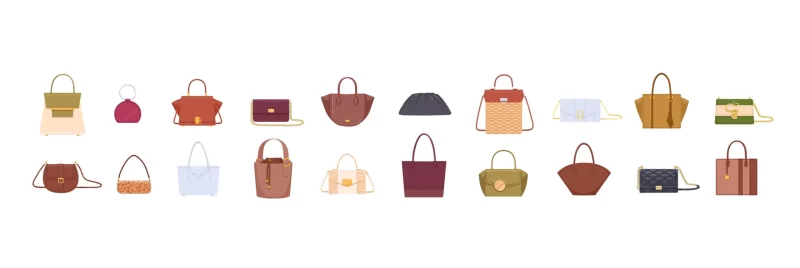
Who this guide is for: brand owners, sourcing managers, wholesale buyers, Amazon FBA sellers, DTC founders, fashion-forward labels, K-beauty and J-fashion influenced brands, and gift-market retailers who are developing custom bow bags, pearl-handle handbags, and satin-ribbon accessories for the 2026 Coquette aesthetic. If you want to understand how to engineer oversized satin bows, pearl bead handles, and delicate hardware into a bag that reads as bespoke luxury rather than costume — and how to produce these technically demanding embellishments through a manufacturer in China — this guide covers the material science, the construction engineering, and the commercial strategy.
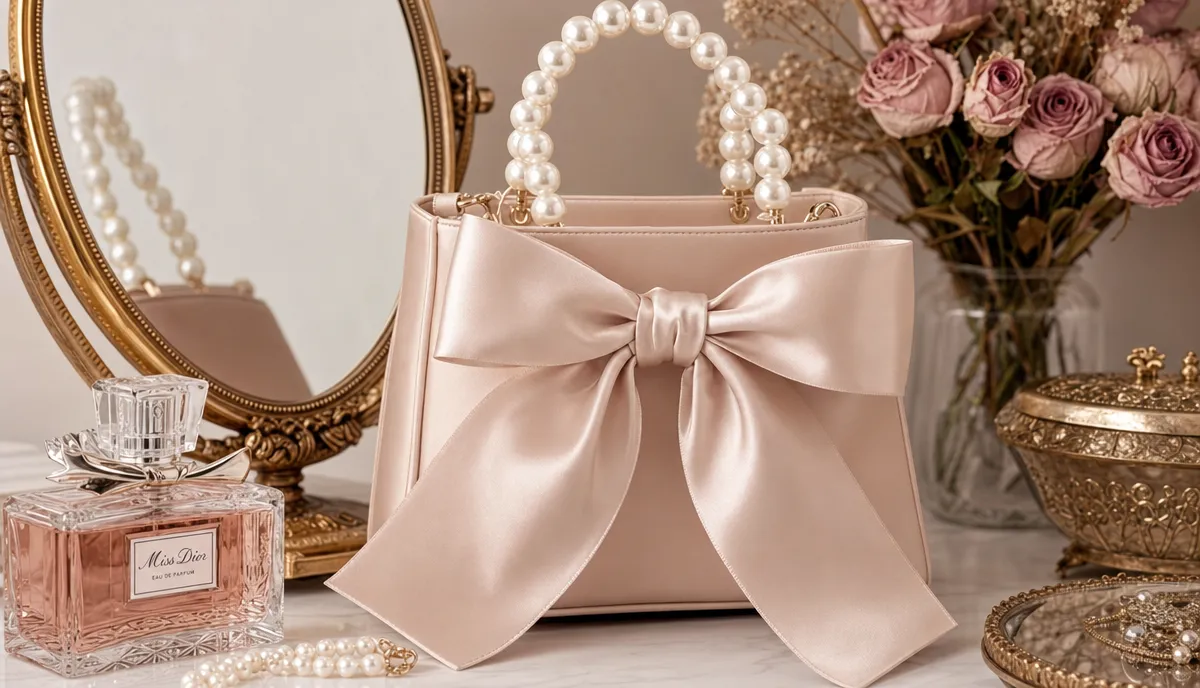
The Coquette aesthetic has completed its metamorphosis. What began in 2023 as a social media microtrend — pink bows, lace, girlish accessories pulled from a teenager’s Pinterest board — has matured by 2026 into something more commercially sophisticated and more technically demanding: elevated Coquette, a design language that retains the feminine iconography (bows, ribbons, pearls, soft textures) but executes it in premium materials, restrained proportions, and fashion-grade construction that reads as bespoke rather than costume.
The difference is everything. A cheap polyester bow hot-glued to a PVC clutch is 2023 Coquette — viral, disposable, and already in a landfill. A hand-finished satin bow architecturally integrated into a structured handbag with pearl bead handles and brushed gold hardware is 2026 Coquette — a product that a 30-year-old woman carries to dinner, that a 25-year-old photographs for her brand, and that a boutique buyer stocks alongside $200 leather goods without visual incongruity.
Search volume for “custom bow bags” has surpassed 30,000 monthly searches, and the long-tail queries — “personalized satin ribbon tote bags,” “customized pearl handle handbags for the Coquette aesthetic” — reveal a consumer who is not looking for mass-produced fast fashion. She is looking for custom-made, material-specific, detail-rich products that can be personalized to her taste. For B2B buyers, this is one of the highest-AOV aesthetic niches in the handbag market: pearl handles, satin bows, and delicate hardware are technically complex to produce, which limits competition and supports premium pricing (250 retail).
This guide covers the elevated Coquette design vocabulary, the engineering of oversized satin bows, the construction and sourcing of pearl bead handles, the satin and silk material landscape, the hardware palette, and how to specify an OEM program that delivers the craftsmanship this aesthetic demands.
Elevated Coquette is defined not by adding more bows, more pearls, and more pink, but by restraint, material quality, and architectural intention. Understanding this vocabulary prevents the most common development mistake: producing a bag that is so heavily embellished it reads as juvenile or costume.
| Principle | What It Means | Design Application | What to Avoid |
|---|---|---|---|
| One statement element | Each bag features ONE dominant Coquette detail — not all of them at once | A bag with an oversized bow OR pearl handles — rarely both simultaneously on the hero surface | Bow + pearls + lace + ribbon + ruffles on the same bag |
| Premium material execution | The Coquette detail is made from the same quality material as the bag body | Satin bow from the same fabric roll as the bag’s satin body; pearls that match the hardware tone | Cheap ribbon glued onto expensive leather; plastic “pearls” on genuine satin |
| Architectural integration | The detail is structurally part of the bag, not applied on top | A bow that is sewn into the seam line and shapes the front panel’s geometry | A bow that is tacked on top of a flat surface like a gift-wrap decoration |
| Muted tones over bright pinks | Champagne, blush, dusty rose, powder blue, ivory — not hot pink or fuchsia | Color palette that reads as “neutral feminine” rather than “Barbie” | Saturated bubblegum pink, neon, or candy-colored palettes |
| Grown-up proportions | Bag dimensions and silhouettes from the adult handbag canon — not toy-sized | A structured top-handle bag, a medium shoulder bag, or a refined clutch | Heart-shaped bags, novelty shapes, micro-bags too small to hold a phone |
For developers choosing which Coquette element to feature, this hierarchy ranks them by 2026 commercial relevance and search demand:
| Element | Search Demand | Production Complexity | Retail Price Impact | Versatility | Recommendation |
|---|---|---|---|---|---|
| Oversized satin bow | Very high — “bow bag” leads all Coquette searches | Medium–High | +40 retail premium | Medium — reads as occasion or fashion | Hero element — strongest trend signal |
| Pearl bead handles | High — “pearl handle bag” is a fast-growing search | High — bead stringing + attachment engineering | +50 retail premium | Medium — reads as elevated, special | Premium hero — highest perceived value |
| Satin / silk body material | High — material itself IS the Coquette signal | Medium — satin requires careful handling | +30 over standard PU | Medium — seasonal, occasion-oriented | Foundation material for the aesthetic |
| Ribbon detailing (edge, strap, closure) | Moderate | Low–Medium | +15 | High — subtle accent works everywhere | Complement element — adds without overwhelming |
| Ruching / gathering | Moderate | Medium | +25 | Medium | Statement technique — works on specific silhouettes |
| Lace overlay / insert | Low–Moderate | Medium–High | +30 | Low — reads as bridal or very specific | Niche — bridal, evening, limited editions only |
The bow is the signature Coquette element — and the one most often executed poorly. A bad bow is floppy, flat, asymmetrical, and reads as an afterthought. A well-engineered bow has structural volume, intentional asymmetry, and architectural relationship to the bag’s body.
| Method | How It Works | Volume / Dimension | Permanence | Quality Read | Cost |
|---|---|---|---|---|---|
| Tied bow (real knot) | Actual satin ribbon tied into a bow, tails left flowing | Low–Medium — depends on ribbon stiffness and width | Low — loosens, shifts, deforms with handling | Medium — looks “real” but often untidy after use | Lowest (+1.50) |
| Structured bow (pre-formed, sewn) | Bow shape is pre-constructed: loops formed over a hidden foam or wire armature, then sewn shut | High — holds its shape permanently | Very high — will not deform | Very high — this is the elevated standard | Medium (+5.00) |
| Integrated panel bow | The bag’s front panel IS the bow — fabric is gathered and stitched to create a bow-like sculptural form | Maximum — the bow is the entire front surface | Permanent — structural | Highest — reads as “designed by an architect” | Highest (+8.00) |
| Detachable bow (clip or pin) | Bow is a separate accessory that clips onto the bag | Variable — depends on bow construction | N/A — removable by design | Medium — versatile but can look “added” | Medium (+4.00 for bow; bag has clip mount) |
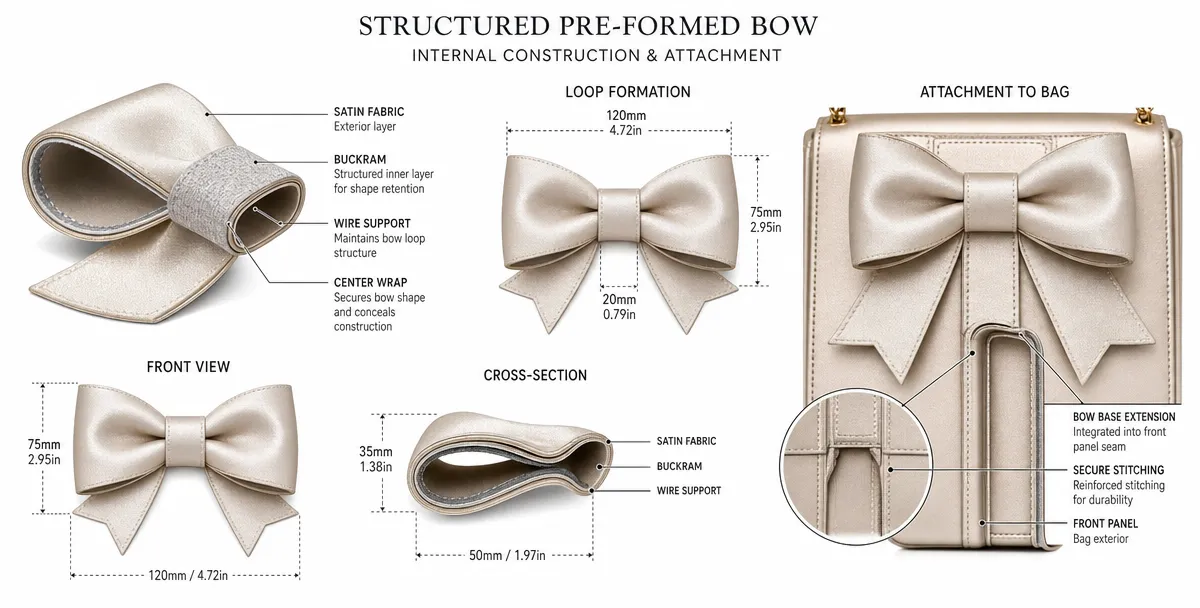
For elevated Coquette bags, the structured pre-formed bow is the industry standard. Here is the detailed specification:
| Element | Specification | Why |
|---|---|---|
| Bow material | Same satin as the bag body — never a different fabric | Material consistency reads as intentional, not decorative |
| Internal support | Lightweight buckram or millinery wire inside each loop | Prevents loops from collapsing; maintains volume after handling |
| Loop count | 2 loops + 2 tails (classic) or 2 loops only (modern/minimalist) | 2+2 is the most recognizable bow format; loop-only reads as more architectural |
| Loop width | 50–80 mm per loop (measured from center knot to outer edge) | Under 50 mm reads as undersized; over 80 mm begins to overwhelm bags smaller than 28 cm |
| Total bow span | 12–18 cm (the full width from one loop tip to the other) | Must be proportional to the bag’s front panel — approximately 40–60% of the panel’s width |
| Tail length | 8–15 cm, angle-cut or V-notched | Tails should be shorter than the bag’s height; angle-cut prevents raw-edge fraying |
| Attachment | Sewn directly into a seam line (front panel center, top edge, or flap fold) | Seam-integrated attachment is permanent and structural; surface-tacked bows eventually detach |
| Position | Front panel center (most common) or off-center top-right (modern, asymmetric) | Center is classic; off-center is more editorial and reads as a deliberate design choice |
| Bag Width | Recommended Total Bow Span | Loop Width | Tail Length | Visual Proportion |
|---|---|---|---|---|
| 20–24 cm (mini/clutch) | 10–13 cm | 40–55 mm | 6–10 cm | Delicate — the bow accents, does not dominate |
| 25–30 cm (small shoulder) | 13–16 cm | 50–65 mm | 8–12 cm | Balanced — the bow is a feature, not the entire surface |
| 31–38 cm (medium tote/shoulder) | 16–20 cm | 60–80 mm | 10–15 cm | Statement — the bow commands attention proportionally |
| 39+ cm (large tote) | 18–24 cm | 70–90 mm | 12–18 cm | Grand — the bow is a sculptural element |
Pearl handles are the Coquette element with the highest perceived value — and the highest production complexity. They transform a bag from “feminine” to “jewelry-grade accessory” and command the strongest retail premiums in the category.
| Pearl Type | Material | Size Range | Visual Effect | Durability | Cost Per Handle (pair) | Recommendation |
|---|---|---|---|---|---|---|
| Glass pearl (recommended) | Glass core coated with pearlescent lacquer | 8–14 mm diameter | Warm luster, weight, satisfying click sound | Very good — scratch-resistant coating | 8.00 | Best balance of beauty, weight, and durability |
| ABS plastic pearl | ABS plastic core with pearl coating | 8–20 mm | Lightweight, uniform, wide size range | Moderate — coating can chip under stress | 3.00 | Budget tier; acceptable for sub-$80 retail |
| Acrylic pearl | Solid acrylic with pearl finish | 10–20 mm | Lightweight, glossy, slightly more translucent | Moderate — can crack on impact | 4.00 | Mid-tier; good for larger beads where weight matters |
| Freshwater pearl (genuine) | Natural freshwater cultured pearl | 6–10 mm | Organic, irregular, genuine luster | Good — natural material, each bead unique | 50.00+ | Ultra-premium only; $200+ retail bags |
| Shell pearl | Shell core coated with pearl essence | 8–14 mm | Very close to genuine pearl appearance | Good — heavier than plastic, lighter than glass | 8.00 | Premium tier; closest to genuine without the cost |
| Element | Specification | Why |
|---|---|---|
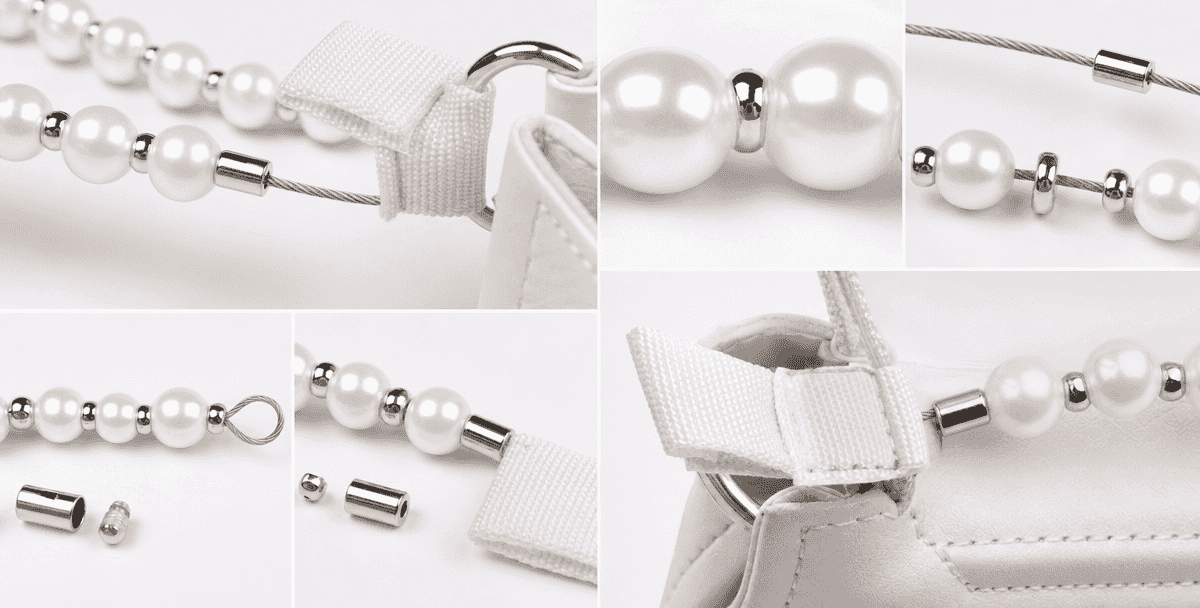
| Bead diameter | 10–12 mm (standard) or 14–16 mm (oversized statement) | 10–12 mm is proportional to most bag sizes; 14–16 mm creates a bolder, more sculptural handle |
| Bead count per handle | 12–18 beads (depending on handle length and bead size) | Must span 20–28 cm with comfortable spacing |
| Stringing wire | Stainless steel wire (0.5–0.8 mm) with nylon coating | Steel provides structural rigidity; nylon coating prevents bead chipping and noise |
| Bead spacing | Directly adjacent (touching) or 2–3 mm spacing with metal spacer beads | Touching = classic, dense look; spaced = lighter, more modern |
| Handle terminals | Metal end caps (matching bag hardware finish) crimped onto wire, sewn through reinforced webbing attachment tab | End caps prevent beads from sliding off; the tab is the structural connection to the bag body |
| Attachment to bag | Reinforced webbing tab sewn through the bag’s side seam or riveted to a leather mounting plate | Pearl handles bear 1–3 kg of bag weight; the attachment must be mechanically strong |
| Grip comfort | Bead diameter 10–12 mm fits naturally in the hand; wire must not flex more than 5 mm under 2 kg load | If the handle flexes too much, beads press painfully into the palm |
| QC test | 5 kg static load for 30 seconds; 1,000 grip-release cycles | Wire must not stretch; end caps must not loosen; beads must not crack |
Pearl handles add noticeable weight compared to fabric or leather handles:
| Handle Type | Weight Per Pair | Bag Impact |
|---|---|---|
| Fabric/webbing handles | 30–60 g | Baseline |
| Leather rolled handles | 60–120 g | Standard |
| Glass pearl handles (12 mm × 15 beads × 2) | 120–200 g | Adds 60–140 g over leather — noticeable but acceptable for occasion bags |
| ABS plastic pearl handles | 40–80 g | Minimal additional weight |
| Freshwater pearl handles | 80–150 g | Moderate — natural pearls are lighter than glass |
Glass pearl handles add approximately 100–150 g over standard handles. For bags carried briefly (evening, events, shopping trips), this is acceptable. For bags intended for all-day carry, consider ABS plastic pearls to reduce handle weight, or offer pearl handles as a detachable option alongside standard handles — the consumer clips on pearl handles for special occasions and swaps to standard handles for daily use.
The Coquette bag body material is as important as the bow or the handles. Satin — with its smooth, light-catching surface and soft drape — is the defining fabric of the elevated Coquette movement.
| Satin Type | Composition | Sheen Level | Drape | Durability for Bags | Cost | Recommendation |
|---|---|---|---|---|---|---|
| Duchesse satin | Silk or silk-blend, heavy weight | Very high — mirror-like | Structured — holds shape | Good — heavy weight resists wrinkling | High (15/m) | Premium — evening and special occasion |
| Charmeuse satin | Silk or polyester, medium weight | High — soft, flowing | Very fluid — drapes beautifully | Moderate — delicate, wrinkles | Medium (8/m) | Best for lining and soft details; too delicate for full-body bags |
| Crepe-back satin | Polyester, reversible (satin one side, crepe the other) | Medium — elegant, not overly shiny | Moderate — balanced structure | Good — the crepe back adds stability | Low–Medium (5/m) | Best overall for bag bodies — structured + lustrous |
| Polyester duchess | 100% polyester, heavy weight | High — close to silk duchess | Structured | Very good — resists wrinkling, affordable | Low (4/m) | Best value — recommended for mass-market Coquette |
| Mikado satin | Silk-polyester blend, rigid | Medium — subtle sheen | Very structured — almost self-supporting | Excellent — the most durable satin | Medium–High (10/m) | Best for structured silhouettes — maintains shape without interlining |
Satin is beautiful but fragile. It snags, watermarks, and shows fingerprints and pressure marks more readily than leather or canvas. For bags (which are handled, set down on surfaces, and pressed against clothing), the material must be treated or reinforced to survive daily interaction.
| Protective Treatment | What It Does | Impact on Appearance | Cost |
|---|---|---|---|
| Scotchgard / fabric protector spray | Creates an invisible barrier against water and light stains | None — invisible | +0.50 per bag (applied at factory) |
| TPU lamination on interior | Bonded film on the back side of the satin, adding structure and water barrier | Slightly changes the drape — stiffer, more structured | +1.50 |
| Interlining (fusible) | Iron-on stabilizer bonded to the satin’s back side before cutting | Adds body and structure; reduces wrinkle visibility | +0.80 |
| Edge binding | All raw satin edges bound with ribbon or bias tape before seaming | Prevents fraying — the #1 failure point in satin construction | +0.60 |
Recommended treatment stack for bag-grade satin: fusible interlining (for structure) + Scotchgard spray (for surface protection) + edge binding (for fray prevention). This three-layer treatment adds approximately 1.90 per unit and transforms fragile satin into a material that can survive regular handbag use.
The 2026 Coquette palette has moved beyond monochrome pink. It is a spectrum of muted feminines, warm neutrals, and unexpected pastels that read as grown-up and intentional.
| Color | Hex Reference | Coquette Read | Versatility | Best Material Pairing | Demand |
|---|---|---|---|---|---|
| Champagne | #F5E6CC | Very high — the “grown-up pink” | Very high — works as a neutral | Satin, PU leather | Hero color |
| Blush pink | #F4C2C2 | High — the category’s signature | High — feminine but not juvenile | Satin, microsuede | Strong staple |
| Powder blue | #B0C4DE | High — unexpected, editorial | Medium — seasonal (spring/summer) | Satin, crepe-back | Growing |
| Ivory / off-white | #FFFFF0 | Medium–High — bridal, pure | Very high — universal | Satin, silk, PU | Perennial |
| Dusty lavender | #B4A7D6 | High — the 2026 Coquette accent | Medium — statement, seasonal | Satin, velvet | Trending |
| Dusty rose | #DCAE96 | Very high — warm, mature pink | High — year-round | Satin, PU leather, suede | Strong staple |
| Black (satin) | #000000 | Medium — “dark Coquette” sub-aesthetic | Very high — the evening neutral | Satin, velvet | Stable |
Recommended launch palette: champagne (hero) + blush pink (staple) + dusty lavender or powder blue (trend accent) + black satin (evening) — four colorways that span the Coquette spectrum from “everyday soft feminine” to “evening statement.”
Coquette hardware must be delicate, warm-toned, and visually lightweight. Heavy industrial hardware (chunky chains, oversized buckles, thick zippers) contradicts the aesthetic entirely.
| Hardware Element | Recommended Finish | Avoid | Why |
|---|---|---|---|
| Zippers | Light gold or rose gold, #3 nylon coil (smallest) | Gunmetal, matte black, #8 or larger | Small, warm-tone zippers disappear into the satin; large dark zippers dominate |
| Zipper pulls | Teardrop or ribbon-shaped pull in matching gold | Standard rectangular pull | Shaped pulls reinforce the feminine design language |
| Chain strap (if used) | Fine-link (3–5 mm), light gold or rose gold | Chunky chain, curb chain, silver | Fine chain reads as jewelry; chunky chain reads as streetwear |
| Closure | Magnetic snap (hidden) or delicate turn-lock | Lobster clasp, plastic buckle | Invisible or jewelry-grade closures preserve the soft surface |
| D-rings | 15–20 mm, light gold | 25 mm+, brushed steel | Small D-rings are proportional to the delicate aesthetic |
| Feet | Omit if possible; if needed, 8 mm domed in matching gold | 15 mm+ flat feet | Small or absent feet preserve the bag’s soft, uninterrupted base line |
A satin-wrapped chain strap — fine gold chain with satin ribbon threaded through each link — is one of the most recognizable Coquette strap treatments. It transforms a functional carry element into a decorative one that reinforces the bow-and-pearl visual language.
Specification:
| Element | Specification |
|---|---|
| Chain | Fine-link (3–5 mm link), zinc alloy, light gold plating |
| Satin ribbon | 10–15 mm width, matching bag body satin, threaded through every other link |
| Total strap length | 100–120 cm (adjustable via a buckle or by doubling/tripling the strap) |
| Shoulder pad | Optional — 25 mm satin-covered foam pad at the shoulder section |
| Attachment | Swivel snap hooks at each end, matching light gold |
Not every bag shape reads as Coquette. The aesthetic favors structured, compact, clean-lined silhouettes that provide a composed surface for bows, pearls, and satin to work against.
| Silhouette | Coquette Suitability | Best Coquette Element | Dimensions | Use Case | Retail Tier |
|---|---|---|---|---|---|
| Structured top-handle (lady bag) | Very high — the quintessential Coquette shape | Pearl handles or oversized bow on front | 22–28 × 16–20 × 10–14 cm | Daytime fashion, event, brunch | 200 |
| Envelope clutch | High — clean flat surface for bow or embellishment | Bow closure at flap or pearl clasp | 25–30 × 15–18 cm | Evening, event, date | 120 |
| Shoulder bag (chain strap) | High — the going-out Coquette bag | Satin-chain strap + subtle bow detail | 22–28 × 16–20 × 6–10 cm | Evening, social, cocktails | 150 |
| Mini bucket bag | Medium–High — soft, feminine shape | Ruching + ribbon drawstring | 18–22 × 20–24 cm | Casual Coquette, daytime | 110 |
| Tote (small structured) | Medium — needs careful execution to avoid looking too utilitarian | Ribbon trim or pearl strap accent | 28–35 × 24–28 × 12–15 cm | Work-to-evening, everyday | 130 |
The structured top-handle “lady bag” is the hero silhouette for Coquette. It provides the visual architecture — the rigid frame, the clean front panel, the defined proportions — against which bows and pearls create maximum impact. The envelope clutch is the natural evening complement.
Coquette personalization follows different typographic rules than other bag aesthetics. Where Tenniscore uses serif capitals and corporate gifting uses block initials, Coquette uses script, flourish, and decorative monogram formats.
| Format | Example | Font Style | Application | Coquette Read |
|---|---|---|---|---|
| Script monogram (2–3 letters) | jlm in flowing connected script | Copperplate, Edwardian, or calligraphic script | Embroidered or foil on satin, leather patch | Very high — the definitive Coquette monogram |
| Single initial with flourish | M with decorative swash above and below | Decorated capital with ornamental strokes | Embroidered center-front or on clutch flap | High — bold, personal, elegant |
| Name in script (full first name) | Jessica in flowing script | Calligraphic | Embroidered or foil on interior lining | Medium–High — intimate, personal |
| Initial + bow icon | M alongside a small embroidered bow motif | Capital + simplified bow illustration | Front panel or leather patch | Very high — combines two Coquette signals |
Thread color for Coquette embroidery: gold metallic, rose gold metallic, or tonal (matching the satin — barely visible, texture-only). Contrast-color thread (navy on pink, black on cream) reads as too graphic for the Coquette aesthetic, which favors subtlety and shimmer over bold contrast.
| Product | Role | Key Element | Material | Retail Price |
|---|---|---|---|---|
| Structured top-handle with bow | Hero — the product that defines the brand | Oversized structured satin bow, front center | Crepe-back satin or polyester duchess, interlaced, Scotchgarded | 180 |
| Pearl-handle shoulder bag | Premium hero — highest perceived value | Glass pearl bead handles, satin-chain strap | Satin body with PU leather base reinforcement | 200 |
| Satin envelope clutch with bow clasp | Evening companion — the event bag | Miniature bow at magnetic flap closure | Satin, lined with contrast-color silk-feel fabric | 90 |
| Script-monogrammed cosmetic pouch | Entry product — gift and upsell | Embroidered script monogram, ribbon zipper pull | Satin exterior, wipeable PU interior | 40 |
This four-product collection provides the hero SKU (bow bag or pearl-handle, depending on which element the brand leads with), an evening piece, and an accessible entry-point/gift product — all unified by the same material palette, hardware tone, and Coquette design vocabulary.
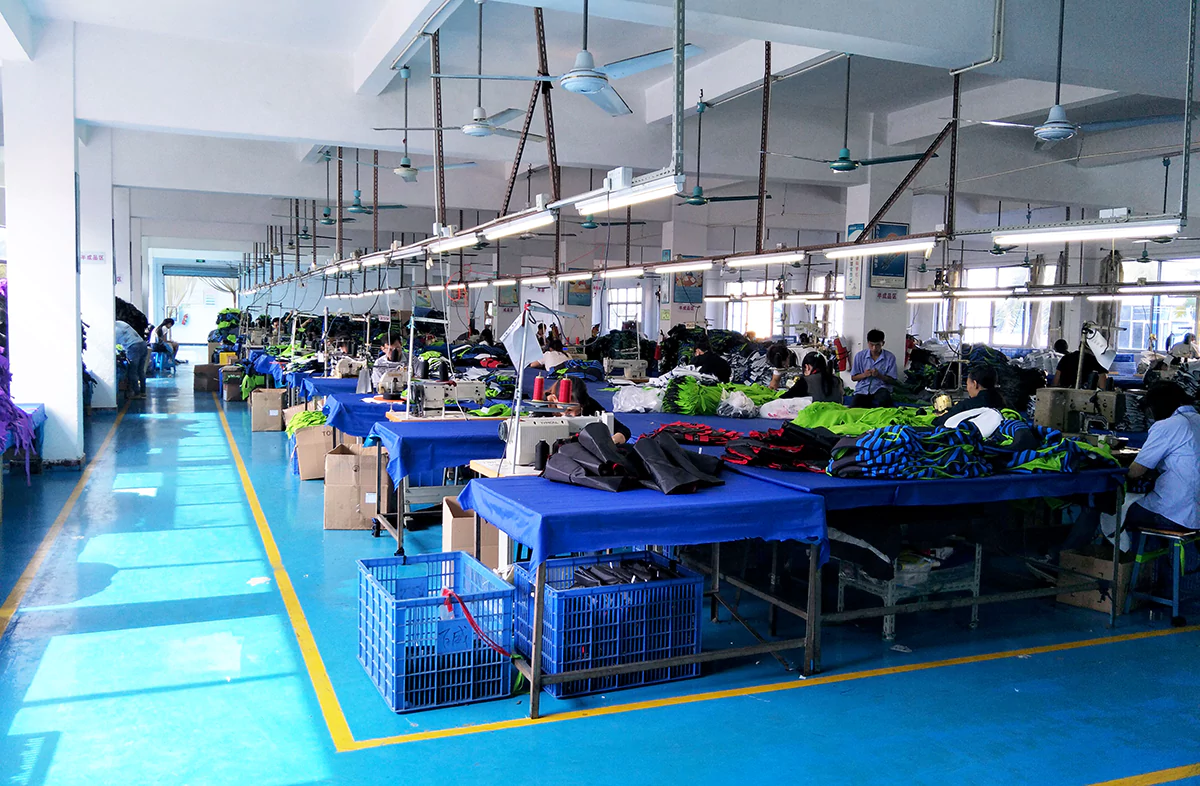
FYBagCustom is Your Trusted Custom Handbag Manufacturer in China, with 15+ years of manufacturing experience producing embellished, hardware-intensive, and fashion-grade handbags for brands worldwide. For buyers developing Coquette and bow-aesthetic bag collections, our capabilities include:
Our 50,000 m² factory in Guangzhou with 10+ production lines produces embellished, fashion-grade, and craft-intensive bag programs for DTC brands, Amazon FBA sellers, boutique retailers, fashion labels, and gift-market companies across international markets.
Elevated Coquette is not about adding more feminine details — it is about executing one or two details at the highest possible material and construction quality, on a silhouette that provides the architectural stage for those details to resonate. For B2B buyers developing bow bags and pearl-handle handbags in 2026, three core takeaways:
If your 2026 collection includes bow bags, pearl-handle handbags, or satin Coquette accessories, now is the time to source satin, approve pearl bead samples, and finalize bow proportions. Contact FYBagCustom to discuss bow construction, pearl handle engineering, and satin treatment — and receive physical samples, typically within 5–7 days.
FYBagCustom’s OEM and ODM team works with fashion brands, DTC founders, Amazon sellers, and boutique retailers to produce custom bow bags, pearl-handle handbags, and satin Coquette accessories — with structured bow engineering, glass pearl handles, delicate hardware, and script monogramming at low MOQ with samples in 5–7 days.
Start Your Custom Bag Project →