Tel/WhatsAapp:+86 18011919834
E-mail: chloe.x@fybagcustom.com

Tel/WhatsAapp:+86 18011919834
E-mail: chloe.x@fybagcustom.com
Send Your Inquiry Today

Who this guide is for: brand owners, sourcing managers, wholesale buyers, Amazon FBA sellers, DTC founders, retail merchandisers, and sustainability-focused product developers who are evaluating vegan leather materials for custom handbag programs in 2026. If you need to understand how mushroom leather, cactus leather, microfiber leather, and advanced PU compare — and what each means for production, cost, and marketing claims — this guide provides the sourcing framework.
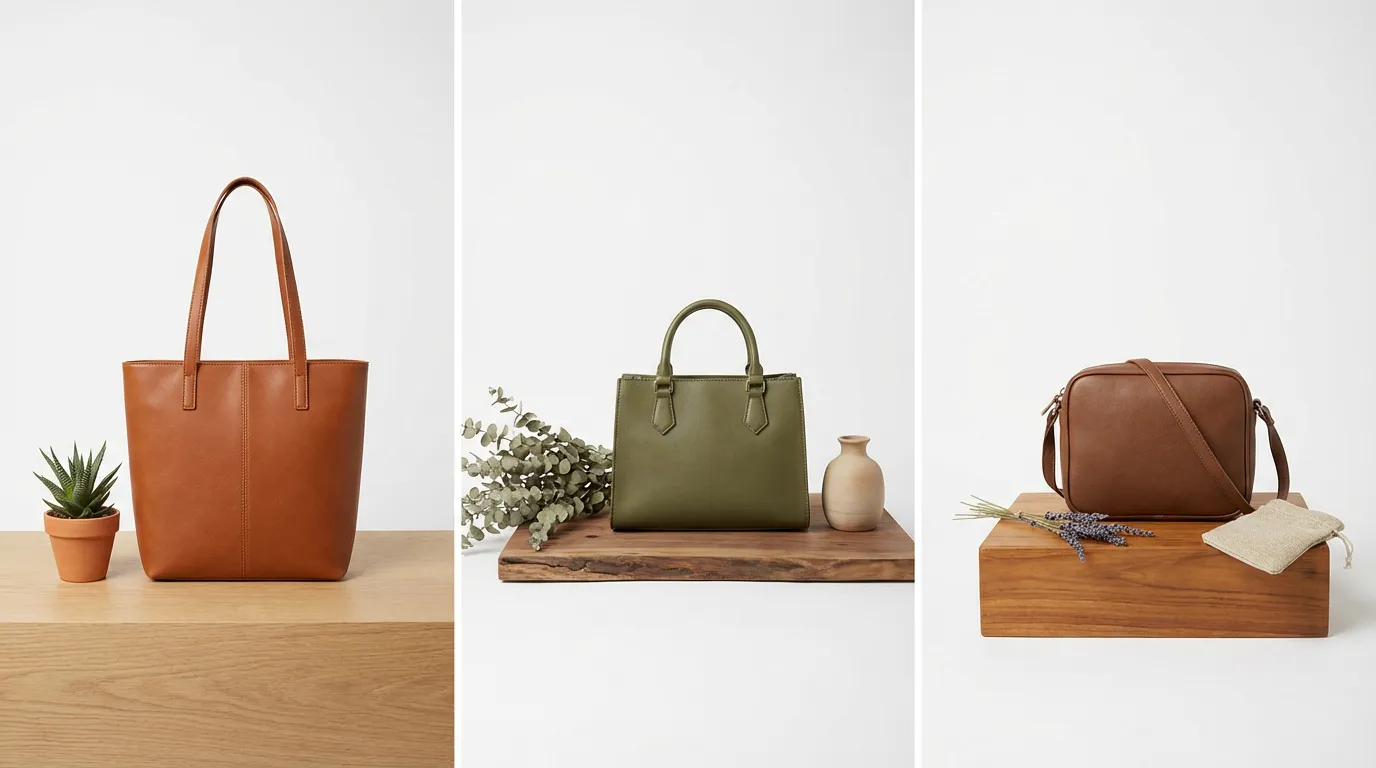
The U.S. handbag market has crossed a threshold. What began as a niche interest among environmentally motivated consumers has become a mainstream purchasing criterion: a growing percentage of American buyers now actively search for bags described as “vegan leather,” “plant-based,” or “sustainable” — and a significant portion will pay more for them. Search volume for vegan leather custom handbags and sustainable custom bags has surged year over year, with 2026 marking the first year that “vegan leather” as a search modifier rivals “genuine leather” in several key product categories.
For B2B buyers, this shift creates a material-selection challenge that did not exist five years ago. The term “vegan leather” now covers a vast spectrum — from conventional PU leather (polyurethane, which has always been vegan) to genuinely novel bio-based materials like mycelium (mushroom) leather and cactus leather, each with wildly different performance characteristics, environmental credentials, cost structures, and commercial readiness. Choosing the wrong material means either overpaying for an unproven innovation or under-delivering on the sustainability story your brand promises.
This guide maps the full landscape of vegan leather options available for custom handbag manufacturing in 2026, compares them honestly on the dimensions that matter to B2B decision-makers, and helps you match the right material to your brand positioning, retail price, and target market.
The term “vegan leather” is a marketing label, not a technical material specification. It means only one thing: the material contains no animal-derived components. Beyond that single fact, vegan leathers vary enormously in composition, environmental impact, durability, and hand-feel. Buyers who treat all vegan leathers as interchangeable will make costly mistakes.
At the broadest level, vegan leather for bags falls into three generations:
First generation — conventional PU and PVC. Polyurethane (PU) and polyvinyl chloride (PVC) synthetic leathers have been used in bags for decades. They are petroleum-derived, affordable, and available in virtually unlimited colors, textures, and finishes. PU is the dominant material in the affordable and mid-market custom handbag category worldwide. PVC is increasingly avoided due to environmental concerns around chlorine-based chemistry and disposal.
Second generation — bio-based and plant-enhanced materials. These materials replace some or all of the petroleum-based components with plant-derived inputs: cactus fiber, apple waste, pineapple leaf fiber (Piñatex), grape marc, mango peel, or corn-based polyols. The base structure is often still a polyurethane or polyester matrix, but the bio-content percentage varies from 20% to over 70% depending on the supplier and formulation.
Third generation — fully novel biomaterials. Mycelium (mushroom) leather is the most prominent example — grown from fungal root structures in laboratory or controlled-agriculture conditions rather than chemically synthesized. These materials are the furthest from conventional manufacturing and carry the highest price premiums, but they also offer the strongest sustainability narratives.
Understanding which generation a material belongs to is essential for two reasons: it determines the accuracy of your sustainability marketing claims, and it determines whether your factory can source and work with the material at scale.
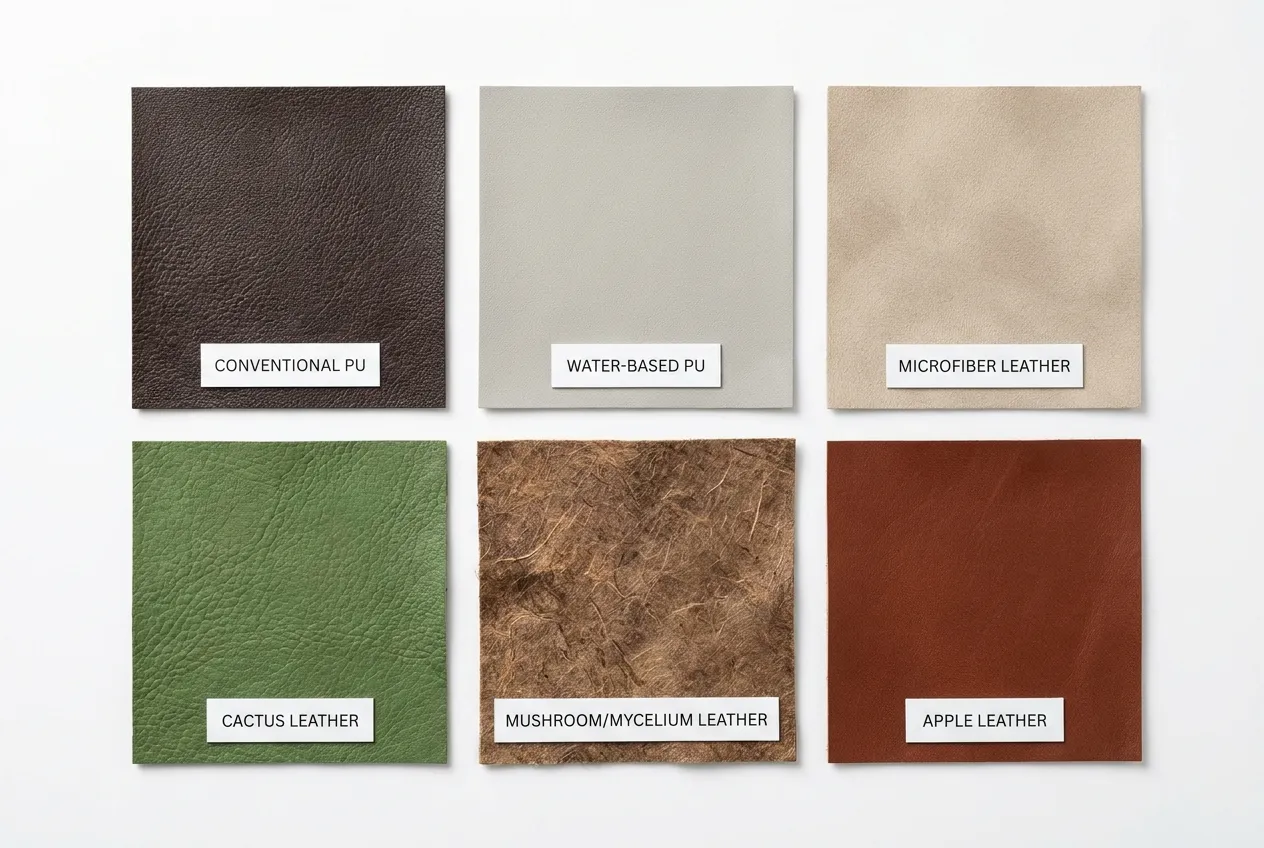
The table below compares the major vegan leather categories available for handbag production in 2026 across the dimensions that matter most to B2B buyers: material composition, hand-feel, durability, environmental credibility, commercial readiness, and cost.
| Material | Composition | Hand-Feel | Durability | Environmental Credibility | Commercial Readiness | Cost vs. Genuine Leather |
|---|---|---|---|---|---|---|
| Conventional PU leather | Polyurethane coating on polyester/cotton base | Smooth, consistent, wide texture range | Good (3–5 years typical use) | Low — petroleum-derived, not biodegradable | Fully mature — unlimited supply | 15–30% of genuine leather |
| Water-based PU (WB-PU) | Polyurethane using water instead of DMF solvent | Similar to conventional PU, slightly softer | Good (3–5 years) | Moderate — eliminates toxic solvent, still petroleum-based | Mature — growing supplier base | 20–40% of genuine leather |
| Microfiber leather (microsuede) | Ultra-fine polyester/nylon fibers in PU matrix | Closest to genuine leather — warm, textured, breathable | Excellent (5–8+ years, superior abrasion resistance) | Low–Moderate — synthetic but long-lasting | Mature — widely available | 40–60% of genuine leather |
| Cactus leather (e.g., Desserto-type) | Nopal cactus fiber blended with bio-based PU / polyester base | Soft, slightly textured, distinctive organic feel | Good (improving with each generation) | High — low water use, partially biodegradable, plant-based | Limited — few licensed suppliers, lead times longer | 60–90% of genuine leather |
| Mushroom / mycelium leather | Mycelium (fungal root) grown on agricultural substrate | Soft, leather-like, unique hand-feel | Moderate — early generations softer than leather | Very high — grown, not manufactured; compostable potential | Early-stage — very limited volume, long lead times | 80–120%+ of genuine leather |
| Apple leather | Apple waste fiber blended with PU / polyester base | Smooth, slightly matte, pleasant | Good | High — upcycled agricultural waste | Growing — more suppliers entering market | 50–80% of genuine leather |
| Pineapple leaf fiber (Piñatex-type) | Pineapple leaf fiber in resin matrix | Canvas-like, textured, non-traditional | Moderate — better for structured bags | High — agricultural byproduct, low-impact | Limited — proprietary suppliers | 50–75% of genuine leather |
| Recycled PU / ocean plastic | Recycled post-consumer or post-industrial waste in PU matrix | Varies — depends on formulation | Good | Moderate–High — diverts waste, still synthetic | Growing — increasing supplier options | 25–45% of genuine leather |
Several patterns emerge from this comparison that are critical for B2B buyers:
Microfiber leather is the performance leader. If your priority is getting as close to genuine leather’s feel and durability as possible while remaining vegan, microfiber is the strongest choice. It outperforms every other vegan option on abrasion resistance and longevity. However, its environmental story is the weakest among the newer materials — it is fundamentally a synthetic product.
Water-based PU is the pragmatic sustainability upgrade. For brands currently using conventional PU, switching to water-based PU (WB-PU) is the lowest-friction improvement. The material looks, feels, and costs nearly the same, but the production process eliminates DMF — a toxic solvent that is a growing regulatory concern in the EU and California. This switch is invisible to the end consumer but meaningful for compliance and brand positioning.
Bio-based materials (cactus, apple, pineapple) occupy the “credible innovation” tier. They offer genuine sustainability narratives backed by plant-based inputs, but they come with trade-offs in cost, supply availability, and sometimes durability. They are best positioned for premium and contemporary brands where the retail price can absorb the higher material cost and the sustainability story is a central part of the brand identity.
Mushroom leather is the frontier. It has the strongest environmental credentials and the most compelling narrative, but it is not yet viable for high-volume OEM programs. Supply is extremely limited, lead times are long, and per-unit costs approach or exceed genuine leather. It is best suited for capsule collections, limited editions, or brands willing to invest in a “first mover” positioning strategy.
The brief specifies the U.S. market, and there are specific regulatory and cultural dynamics in America that make vegan leather particularly relevant for brands selling there.
California’s Proposition 65 and the state’s evolving chemical disclosure requirements create compliance overhead for any material that uses certain solvents, heavy metals, or restricted substances in its production. Water-based PU and bio-based materials inherently reduce exposure to Prop 65-related chemicals, simplifying compliance for brands selling in California — which functionally means any brand selling on Amazon or through major U.S. retailers.
Additionally, the FTC’s Green Guides govern how environmental claims can be made in the U.S. market. Terms like “eco-friendly,” “sustainable,” and “green” are subject to scrutiny if not substantiated. Brands using vegan leather must be able to specify exactly what makes their material environmentally preferable — a vague “vegan = eco” claim without supporting detail is a regulatory risk. This is why understanding your material’s composition and sourcing chain is not just a procurement task but a legal one.
American consumers under 40 — the primary demographic driving DTC and fashion-forward handbag purchases — show the strongest preference shift toward vegan and sustainable materials. This is not theoretical: it shows up in search volume, conversion rate data from Amazon and Shopify, and wholesale reorder patterns from U.S. retail buyers who report that “vegan leather” as a product-page keyword measurably improves click-through.
Relative search volume indexed to 2021 = 100. U.S. market only.
Vegan leather search interest has tripled since 2021 in the U.S. while genuine leather remains flat. Crucially, this is not a zero-sum replacement — consumers are adding “vegan leather” as a positive search filter, not just avoiding “leather.” This means brands offering vegan options are expanding their addressable audience rather than simply switching existing customers from one material to another.
B2B buyers need a balanced view, not a sustainability sales pitch. Every vegan leather option involves trade-offs. The table below presents an honest pros-and-cons assessment for each major category.
| Material | Pros | Cons | Biggest Risk for Buyers |
|---|---|---|---|
| Conventional PU | Lowest cost, widest supply, proven durability, any color/texture | Petroleum-based, not biodegradable, weak sustainability story | Consumer backlash if marketed as “eco” without qualification |
| Water-based PU | Eliminates toxic solvents, easy supplier switch, similar cost | Still petroleum-based at its core, “water-based” story is subtle | Over-claiming — WB-PU is better, not transformative |
| Microfiber leather | Best hand-feel and durability, closest to genuine leather | Synthetic, not biodegradable, higher cost than PU | Positioning confusion — feels like leather but is fully synthetic |
| Cactus leather | Strong plant-based narrative, low water footprint, genuinely innovative | Limited suppliers, longer lead times, still contains synthetic binder | Supply chain fragility — few sources means risk if demand spikes |
| Mushroom / mycelium leather | Strongest environmental credentials, compelling brand story | Very limited availability, high cost, durability still improving | Over-investing in unscalable material for a volume program |
| Apple leather | Upcycled waste story, good aesthetics, growing availability | Still uses PU binder, bio-content percentage varies by supplier | Unverified bio-content claims from some suppliers |
| Pineapple leaf fiber | Agricultural byproduct, unique texture, strong origin story | Non-traditional look, requires coating for water resistance | Consumer expectation mismatch — doesn’t look or feel like leather |
| Recycled PU / ocean plastic | Waste diversion narrative, concrete recycled-content metric | Quality varies, recycled content percentage can be low | Greenwashing risk if recycled content is below 30% |
One of the most important — and most often obscured — details in bio-based vegan leather is the bio-content percentage. A material marketed as “cactus leather” may contain 30% cactus fiber and 70% conventional polyester and PU, or it may contain 65% cactus fiber and 35% bio-PU. The difference matters enormously for both environmental credibility and regulatory compliance.
When sourcing bio-based vegan leather for the U.S. market, always request:
These data points protect your brand against greenwashing accusations and FTC scrutiny, and they give your marketing team defensible claims to put on product pages.
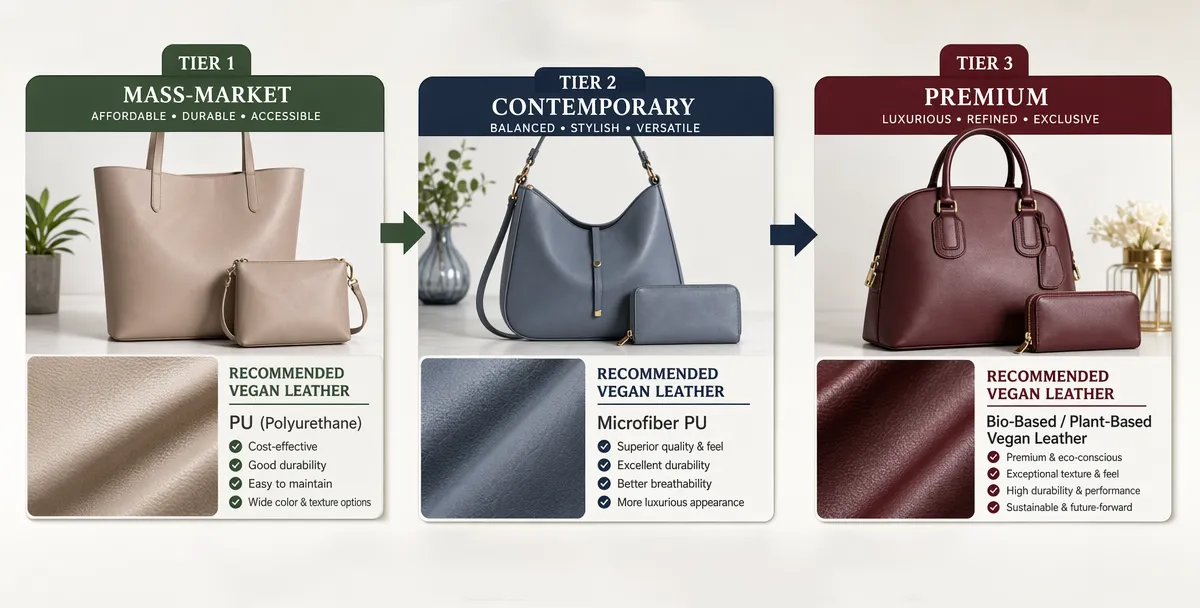
Not every vegan leather is right for every brand. The strongest programs match material choice to brand identity, retail price point, order volume, and target consumer profile.
| Your Brand Profile | Recommended Material | Why This Match | Retail Price Range (Handbag) | Minimum Viable Order |
|---|---|---|---|---|
| Amazon FBA / mass-market | Water-based PU | Cost-effective, genuine improvement over conventional PU, easy supply | 50 | Standard — readily available |
| Mid-price DTC / contemporary fashion | Microfiber leather or recycled PU | Premium feel, strong durability, defensible sustainability angle | 100 | Standard — multiple supplier options |
| Premium / sustainability-forward DTC | Cactus leather or apple leather | Genuine bio-based innovation, compelling product-page story | 180 | Higher — fewer suppliers, longer lead times |
| Ultra-premium / capsule collections | Mushroom / mycelium leather | Strongest environmental story, press-worthy, first-mover credibility | 350+ | Very limited — plan 6+ months ahead |
| Corporate gifting / promotional | Recycled PU or recycled PET-blend fabric | Concrete “recycled content” metric, cost-appropriate for gifting | 40 | Standard — growing options |
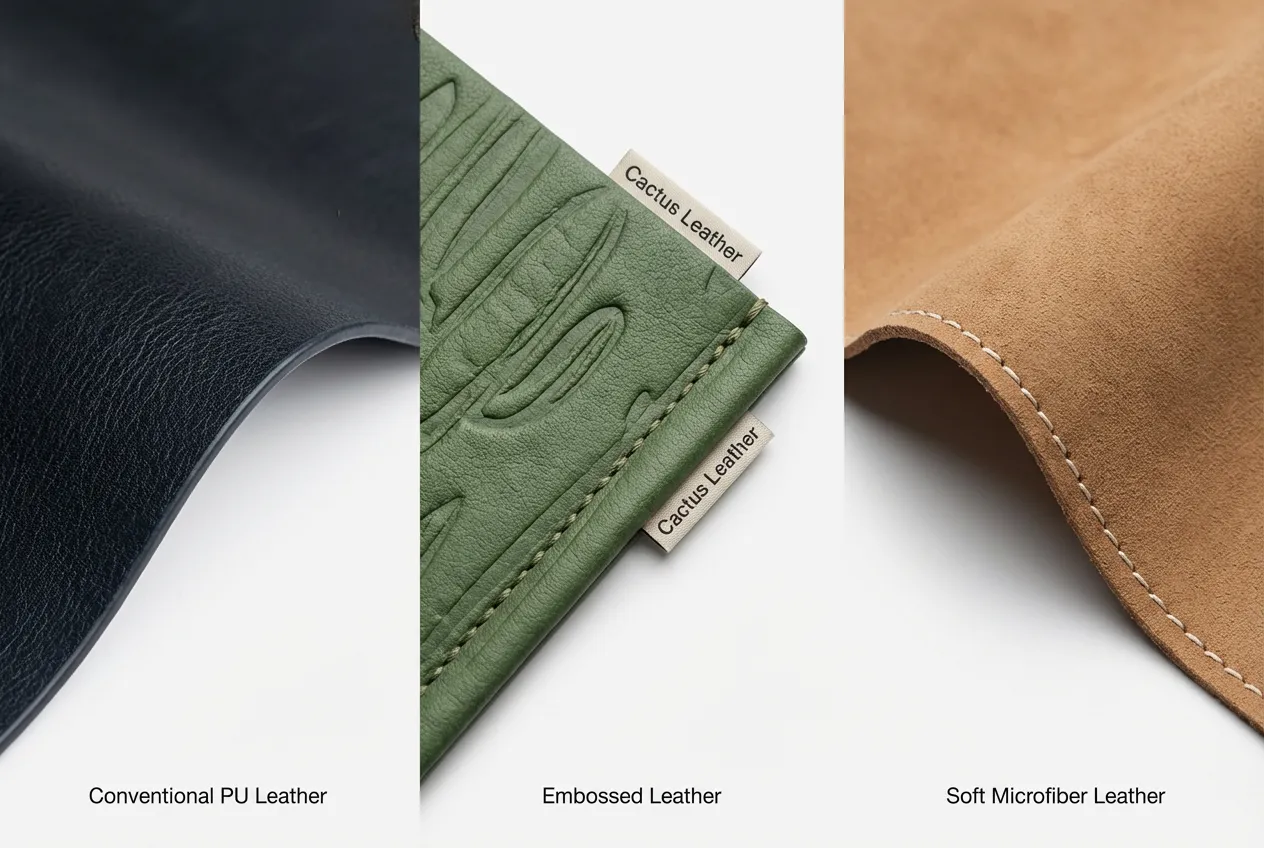
Vegan leather materials do not all behave the same way during bag construction. Some accept embossing beautifully; others crack. Some hold edge paint cleanly; others require edge folding. For OEM buyers, understanding these construction behaviors is essential for writing accurate tech packs.
| Construction Detail | Conventional / WB-PU | Microfiber Leather | Cactus Leather | Mushroom Leather | Apple Leather |
|---|---|---|---|---|---|
| Embossing / debossing | Excellent — holds detail sharply | Good — slightly softer definition | Moderate — test sample first | Limited — material too soft for deep emboss | Good — clean results |
| Edge painting | Good — standard process | Excellent — absorbs paint cleanly | Moderate — some formulations resist | Not recommended — edge folding preferred | Good |
| Edge folding | Good | Excellent | Recommended default | Recommended default | Good |
| Stitching | Standard needle, no issues | Standard needle, clean holes | Use smaller needle — material can tear at stitch points | Requires careful handling — pre-punched holes recommended | Standard needle |
| Heat transfer printing | Good | Good | Test adhesion — coating varies | Not recommended | Moderate — test adhesion |
| Foil stamping | Excellent | Excellent | Good — lower temperature setting | Not recommended | Good |
| Hardware attachment (rivets, screws) | Standard — no reinforcement needed | Standard | Reinforce with backing — material can stress around hardware | Always reinforce — material is softer | Standard — light reinforcement advised |
This table is worth sharing with your factory at the tech pack stage. If your manufacturer has not worked extensively with your chosen bio-based material, request a construction test panel — a sample panel with embossing, stitching, edge treatment, and hardware attachment executed on the actual material — before committing to a full bag sample. This catches compatibility issues early and saves revision cycles.
Marketing a handbag as “sustainable,” “eco-friendly,” or “green” in the U.S. requires more care than many brands realize. The FTC’s Green Guides, which govern environmental marketing claims, establish clear principles that apply to vegan leather products.
For brands selling through Amazon, note that Amazon’s Climate Pledge Friendly badge has specific qualification criteria — water-based PU and recycled-content materials may qualify under certain certifications, while conventional PU will not.
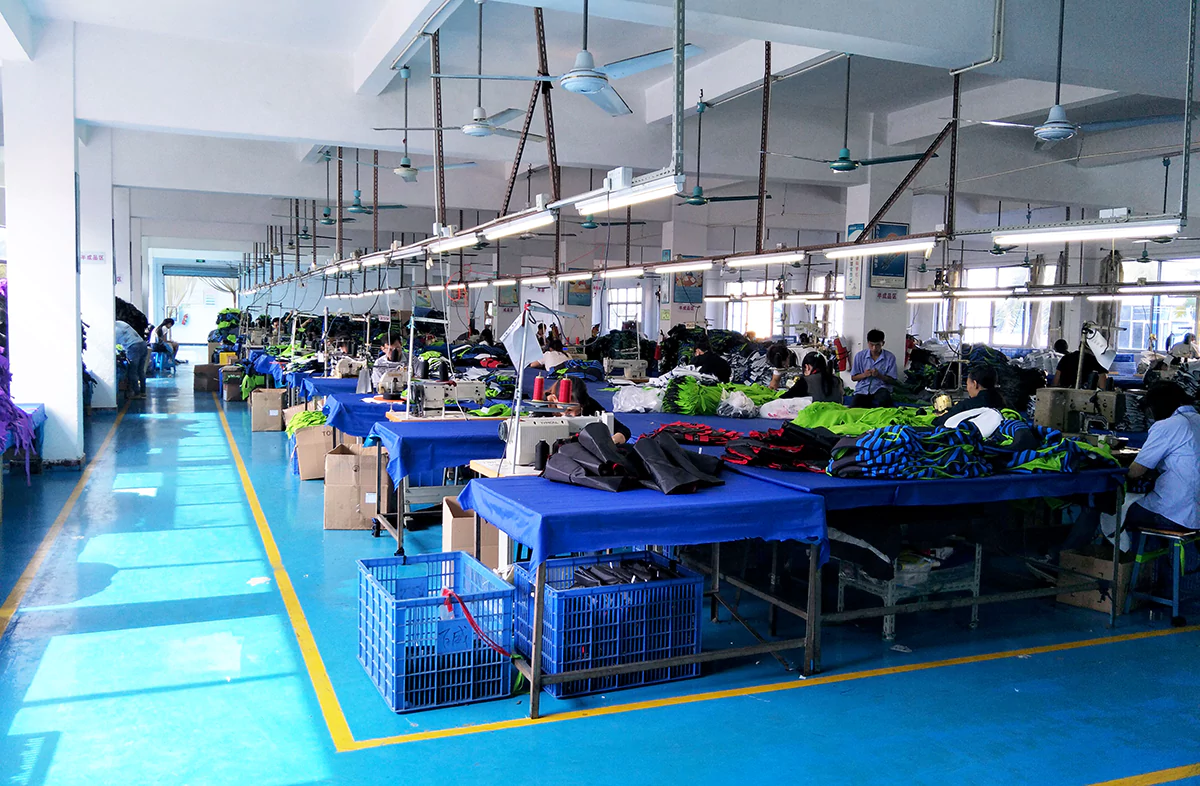
FYBagCustom is Your Trusted Custom Handbag Manufacturer in China, with 15+ years of manufacturing experience producing handbags in PU leather, eco-friendly materials, and recycled fabrics for brands worldwide. For buyers developing vegan leather custom handbag programs, our capabilities include:
Our factory in Guangzhou has produced vegan leather programs for DTC brands, Amazon FBA sellers, retail boutiques, corporate gifting clients, and sustainability-focused labels across international markets.
The vegan leather category has matured beyond a simple “animal-free alternative” into a complex material landscape with genuine innovation, meaningful trade-offs, and significant marketing implications. For B2B buyers developing custom handbag programs for the U.S. market in 2026, three core takeaways:
If your 2026 collection includes vegan leather handbags for the U.S. or global market, now is the time to request material swatches, run construction tests, and lock in sourcing. Contact FYBagCustom to discuss vegan leather options, receive physical samples, and get transparent quotations — typically within 48 hours.
FYBagCustom’s OEM and ODM team works with sustainability-focused brands, Amazon sellers, DTC founders, and corporate programs to produce custom vegan leather handbags — with eco-friendly material sourcing, construction testing for new materials, low MOQ, and samples in as few as 5 days.
Start Your Custom Bag Project →