If you design, source, or sell travel bags, the phrase “American Airlines carry-on compliant” isn’t just marketing copy—it’s a spec you can’t afford to get wrong.
American Airlines is one of the largest carriers in the world, and its carry-on rules are broadly in line with other major US airlines. That means if your bag works for American Airlines, it will likely work for many US and international travelers too, making it a powerful reference standard.
This guide walks through:
Exact carry-on and personal item size limits for American Airlines
Special items (garment bags, musical instruments, pets) and what counts as “free” extras
TSA liquids & prohibited items in carry-ons (and how bags can be designed around that)
Real-world enforcement in 2026 (including American Airlines removing metal gate sizers)
How bag brands, wholesalers and Amazon sellers can spec & design AA-compliant bags
How a Chinese OEM/ODM manufacturer like fybagcustom can support private label projects
Quick note: Policies can change. All rules here are based on American Airlines and TSA information checked in December 2025. Always confirm details on American Airlines’s site and TSA before finalising your product specs.
1. Why American Airlines Carry-On Rules Matter to Bag Brands
If you’re a brand owner, importer, wholesaler or Amazon seller, American Airlines’s carry-on policy matters for three reasons:
Customer expectations Many travelers search specifically for “22x14x9 American Airlines carry-on” or “American Airlines personal item backpack”. If your bag doesn’t match what they expected, you get returns, negative reviews and claims.
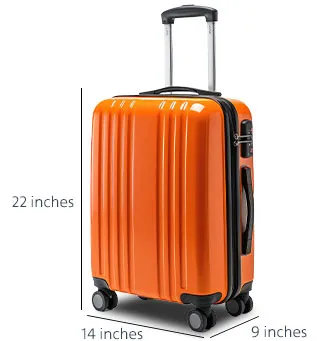
Multi-airline compatibility American’s max carry-on dimensions (22 x 14 x 9 in, including wheels and handles) are basically aligned with United and Delta’s published limits. So optimizing for American Airlines usually keeps you safe across most major US carriers.
Clear spec when talking to factories Instead of saying “standard cabin-size trolley”, you can give concrete specs like 21.5 × 13.5 × 9 in finished size and tolerance. That reduces risk in sampling and mass production.
2. Quick Reference: American Airlines Carry-On & Personal Item Rules
Here’s a quick snapshot of American Airlines’s official policy for standard passengers (excluding special cases like mobility devices):
Item Type
How Many Free?
Max Size (inches)
Where It Must Fit
Notes
Carry-on bag
1
22 x 14 x 9(56 x 36 x 23)
Overhead bin or under seat
Size includes handles & wheels.
Personal item
1
18 x 14 x 8(45 x 35 x 20)
Under seat in front
e.g. purse, laptop bag, small backpack.
Soft-sided garment bag
Counts as carry-on
Up to51 in total(L+W+H)
Overhead bin
Alternative to suitcase.
Extra “free” items
Not counted toward 1+1
Functional items only
Varies
E.g. diaper bag, stroller, wheelchair, breast pump.
American Airlines allows 1 carry-on + 1 personal item in all cabins, including Basic Economy.
3. Carry-On Bag Size Limits (22 × 14 × 9 in)
3.1 Official maximum carry-on dimensions
American Airlines states that your carry-on must not exceed:
22 x 14 x 9 inches (56 x 36 x 23 cm) – including wheels and handles.
And it must fit in the sizer at the airport. If it doesn’t, it needs to be checked (usually with a fee).
From a product development perspective, that “including handles and wheels” line is critical:
Spinner/trolley wheels often add 1–1.5 in of depth.
Telescopic handles and corner protectors can add 0.5–1 in to height and length.
Many consumer luggage brands design their “22-inch carry-on” bags at ~21–21.5 in body height to stay compliant once hardware is included.
3.2 Linear dimensions vs exact sides
Some airlines use “linear inches” (L+W+H) for checked bags. American Airlines’s carry-on limit is side-specific, not linear. That means a bag that is:
23 x 13 x 9 in → Too tall even if total linear size looks similar.
21 x 15 x 9 in → Too wide.
For your spec sheet and tech pack, always specify:
L (length) – often measured horizontally along the front
W (width) – “depth” from front to back
H (height) – from bottom of wheels/feet up to top handle
…and mark clearly whether you’re measuring including or excluding wheels and handles (you should align with American Airlines: including).
3.3 Overhead bin fit and aircraft types
American Airlines’s rule is the same across the network, but physical bins vary:
Standard mainline aircraft (A320, 737, 787, etc.): overhead bins are designed for a 22 x 14 x 9 carry-on placed wheels-first.
Regional jets (American Eagle) can have much smaller bins; American Airlines warns that larger items will need to be “valet checked” (gate-checked) even if they meet 22 x 14 x 9.
As a bag brand, you can reduce complaints by:
Marketing honestly: “Meets American Airlines size for standard cabins; may need gate-check on some regional jets.”
Keeping your bag on the slimmer side of the width and depth limits (many bins are more forgiving on height than on depth).
4. Personal Item Size Limits (18 × 14 × 8 in)
American Airlines defines a personal item as something like a purse, laptop bag or small backpack that fits under the seat in front of you. Its maximum dimensions:
18 x 14 x 8 inches (45 x 35 x 20 cm).
Common examples:
Slim laptop backpack
Briefcase
Camera bag
Medium tote that can squash under a seat
For design & sourcing, three realities matter:
Under-seat space is smaller than the numbers suggest. Power boxes, seat rails and life vests reduce usable space, so many frequent travelers prefer bags closer to 16–17 x 13 x 7 in even though American Airlines allows up to 18 x 14 x 8.
Soft structure > hard structure. Personal items are often nudged, squashed and reshaped under seats. Soft-sided bags (nylon, polyester, canvas) with flexible panels perform better than semi-rigid structures.
“Wearable bags” usually still count. Crossbody bags, slings and fanny packs, even if worn, are generally treated as personal items by US airlines, not as clothing. Enforcement varies, but a safe assumption for your customers is that two bags is the max (1 carry-on + 1 personal).
Many premium or business travelers care about these categories, so they can be powerful niches for private label lines.
5.1 Soft-sided garment bags
American Airlines allows a soft-sided garment bag as your carry-on instead of a suitcase, with a maximum of:
51 in / 130 cm total (L+W+H).
Design implications:
You have more flexibility in shape (tri-fold, bi-fold, half-suiter) as long as length + width + height ≤ 51 in when folded.
Lightweight frames and good hanger systems are crucial; heavy garment bags can be harder to stow than a trolley case.
5.2 Musical instruments
American Airlines allows many musical instruments in the cabin as long as they fit in the overhead bin or under the seat—these usually count as the passenger’s carry-on item.
Opportunities:
Slim guitar gig bags and violin/viola cases sized with overhead bins in mind
Interior padding, neck supports and bow compartments designed to keep overall outer size compact
For oversized or particularly valuable instruments, travelers may buy an extra seat; that’s more about airline policy than bag design, but keeping your case as compact as possible expands potential markets.
5.3 Carry-on pets
American Airlines allows small pets in the cabin on certain routes, inside a soft-sided carrier that fits under the seat; the carrier counts as a carry-on or personal item and incurs a pet fee.
Design notes:
Dimensions must align with under-seat space, so staying at or below the personal item limit is wise.
Ventilation, removable pads and leak-resistant bases are key features that can differentiate your product line.
6. TSA Liquids & Prohibited Items in Carry-On Bags
American Airlines follows TSA rules for what can be carried through security in the US.
6.1 The TSA 3-1-1 liquids rule (still active in 2026)
The core rule remains:
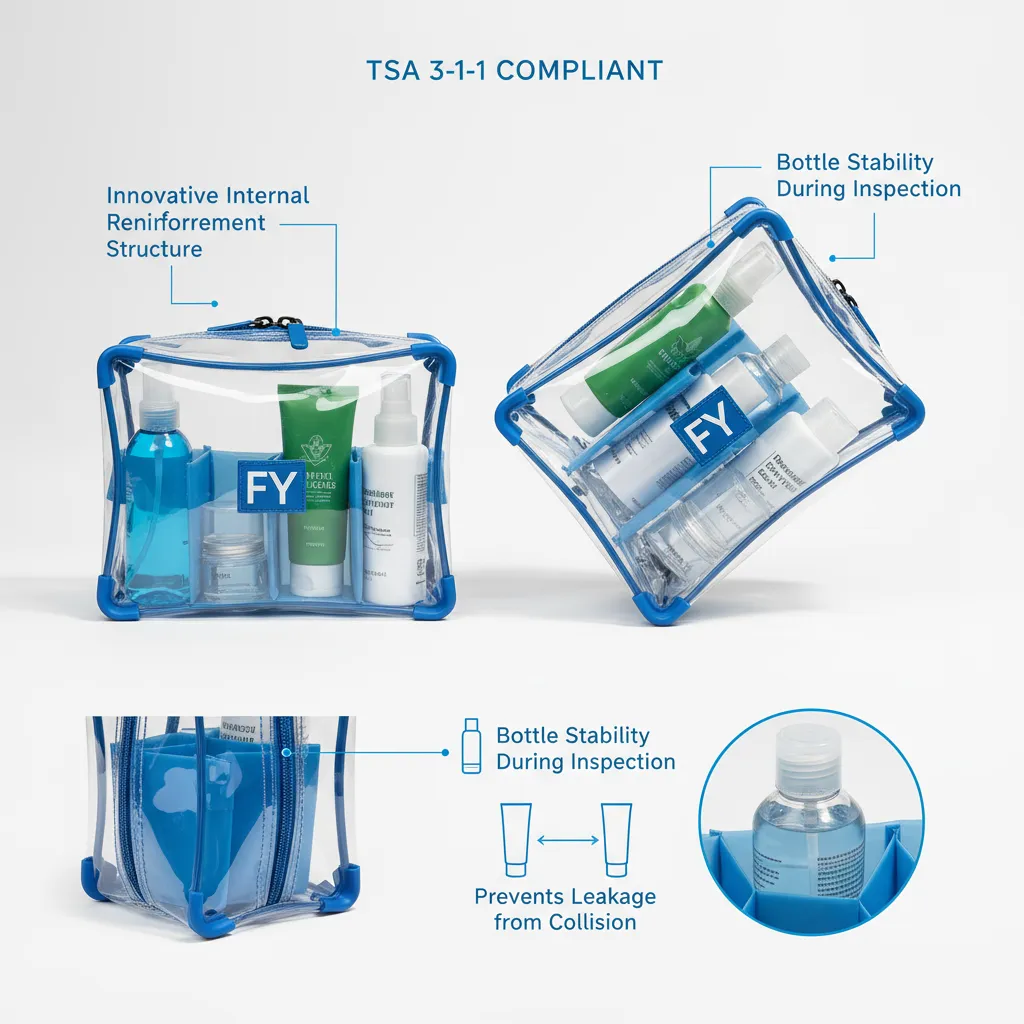
Each container of liquids, gels, creams and aerosols in your carry-on must be 3.4 oz / 100 ml or less.
All such containers must fit into one quart-sized, clear, resealable plastic bag.
Each passenger is limited to one such liquids bag.
For bag design, this creates a clear feature opportunity:
Dedicated transparent / mesh pocket sized for a 1-qt liquids bag near the top or front of the bag, ideally removable.
Quick-access top pocket that can open fully at security without unpacking the whole bag.
6.2 Commonly allowed items
Beyond the carry-on and personal item, passengers can usually bring:
A coat or jacket
A pillow or small blanket
Diaper bag (for a child)
Duty-free items purchased after security
Medically necessary items and assistive devices (often exempt from liquid limits, but subject to extra screening)
These don’t need special bag design, but smart marketing can highlight features like:
Jacket straps or external lash points
Trolley sleeve plus separate diaper-bag compartments
6.3 Prohibited & restricted items
TSA provides a detailed “What Can I Bring?” guide with specific rules for sharp objects, tools, aerosol sprays, self-defense items, etc.
As a manufacturer, you obviously don’t control what buyers pack—but your design can help:
Separate, padded compartment for a laptop/tablet to remove quickly at security.
Color-coded or labeled pockets (e.g., “Liquids”, “Electronics”) to make compliant packing intuitive.
7. Real-World Enforcement in 2026
Designing to the official numbers is one thing; how rules are enforced in reality is another.
7.1 Removal of metal gate bag sizers
In late 2025, American Airlines began removing many of its metal carry-on bag sizers from boarding gates across the US to simplify boarding. (newsweek)
Key points:
Carry-on size rules did not change. The maximum is still 22 x 14 x 9 in plus a personal item that fits under the seat.
Sizers are still used in lobby/check-in areas.
Internal guidance reportedly encourages staff to favor customers when size is borderline rather than aggressively gate-checking in ambiguous cases. (nypost)
For brands and sellers, this means:
Some slightly “over-spec” soft bags might get through without issues if they squish down.
But designing your finished size clearly within 22 x 14 x 9 is still the safest claims approach.
7.2 Basic Economy and overhead bin space
American Airlines Basic Economy tickets include the same 1 carry-on + 1 personal item allowance as other fares, but they board last (Group 9 for most domestic flights). Overhead bins are often nearly full by then, and American Airlines warns that many Basic Economy passengers will need to check their carry-on at the gate.
Implications:
Travelers may want more optimized personal items with enough capacity to survive even if the main carry-on is gate-checked.
Marketing a set (carry-on + underseat personal item) can be attractive to this segment.
7.3 Checked bag fees if carry-on is too big
From a product point of view:
Customers will punish non-compliant products in reviews (“Bag was too big, had to pay $40!”).
Designing conservatively within published limits protects your brand and reduces return risk.
Small measuring differences between customers/airports
With these specs, you can confidently claim “Designed to meet American Airlines carry-on size requirements (22 x 14 x 9 inches)” while giving yourself safety margin.
8.2 Typical volumes and layouts
For a 21.5 x 14 x 9 in soft or semi-rigid bag, you’re usually in the 36–45 L range, depending on shape.
Good design patterns:
Front-opening suitcase (clamshell) with split compartments
Soft-sided travel backpack with panel loading and internal compression straps
Hybrid wheeled duffel for more casual travel
8.3 Spinner vs two-wheel vs backpack
From a product line perspective:
Spinner (4-wheel) carry-on
Premium feel, easy movement.
Wheels often protrude, so you must control depth carefully to stay under 9 in.
Two-wheel upright
Wheels usually partly recessed; easier to keep within 9 in depth.
More durable over rough ground.
Travel backpack (no wheels)
Lighter, more flexible.
Easier to compress into sizers and bins.
Great for “one-bag travel” customers and younger demographics.
Offering multiple formats built on the same American Airlines-compliant footprint can streamline pattern making and production at the factory level.
8.4 Features that specifically support American Airlines/TSA travel
To appeal to frequent American Airlines flyers, consider:
Laptop compartment
Padded, suspended from bottom (drop protection).
Positioned closest to back for comfort and balance.
Quick-access liquids pocket
Designed around a 1-qt bag; large U-shaped opening.
Optionally transparent or mesh.
ID & boarding pass organization
Ticket pocket, passport slot, plus RFID-protected card pocket.
Internal tie-down straps & mesh dividers
Helps compress clothes to reduce bulging over depth limits.
9. Designing Personal-Item Bags That Fit Under the Seat
Personal-item bags are an excellent complementary product for your AA-compliant carry-on line.
9.1 Recommended spec ranges for personal item bags
Even though American Airlines allows 18 x 14 x 8 in, designing a bit smaller makes for happier customers:
Position
American Airlines Max
Recommended Finished Spec (Outer)
Height
18 in
15.5 – 17.0 in
Length
14 in
12.5 – 13.5 in
Depth
8 in
6.5 – 7.5 in
Volume target: typically 18–28 L, depending on structure—enough for:
1–2 days of clothes
Laptop + tech pouch
Toiletry kit (within TSA rules)
Essentials like snacks, documents, chargers
9.2 Popular personal-item formats
Under-seat travel backpack
Front-panel opening, suitcase-style compartment for clothes
Separate padded laptop pocket
Under-seat duffel / weekender
Top-opening duffel with trolley sleeve
Great for couples/families as “shared overflow” bag
Business briefcase / laptop bag
Slim, formal aesthetics
Works for corporate programs and frequent business travelers.
Features to highlight:
Trolley sleeve to sit over the carry-on handle
Soft base so the bag can deform under the seat
Grab handles for quick removal during boarding
10. Materials, Weight & Construction Considerations
While American Airlines doesn’t publish a specific carry-on weight limit on its site for most routes, bags still need to be light enough for passengers to lift into the overhead bin unaided.
From a design and sourcing standpoint:
10.1 Target weight ranges
For American Airlines-style carry-on:
Wheeled soft-sided carry-on: aim for 2.8–3.5 kg (6.2–7.7 lb)
Wheeled hardshell carry-on: aim for 3.0–3.7 kg (6.6–8.2 lb)
Travel backpack (no wheels): aim for 1.0–1.8 kg (2.2–4.0 lb)
Heavier than this, and customers may complain, especially if they routinely pack close to the limits of what they can lift.
10.2 Material comparisons (for American Airlines-compliant bags)
Material
Pros
Cons
Best Use Cases
1680D/1200D Nylon
Very strong, abrasion-resistant, premium look
Higher cost, slightly heavier
Business carry-ons, high-end backpacks
600D/900D Polyester
Cost-effective, good printability, lighter
Slightly less abrasion resistance than nylon
Mid-range suitcases, branded sets
PC/ABS Hardshell
Strong structure, good impact resistance, sleek look
Less flexible in sizers, scratches show
Spinner cases marketed as “cabin trolley”
Canvas (cotton or poly-cotton)
Casual, lifestyle aesthetic
Can be heavier, may absorb moisture
Weekenders, duffels
RPET (recycled poly)
Sustainability story, marketing advantage
Some suppliers have higher MOQs/pricing
Eco-focused lines
Choosing materials is not just about aesthetics; it affects:
Finished weight
Durability and warranty claims
Perceived quality vs price point
fybagcustom, as a China-based OEM/ODM manufacturer, can normally source:
Standard nylon, polyester, RPET in many deniers
Custom prints, colors, and coatings (PU, PVC-free, etc.)
Hardware (zippers, wheels, handles) from branded or generic suppliers, depending on your budget and positioning.
If a bag doesn’t meet American Airlines’s carry-on size rules and has to be checked, passengers may pay checked bag fees. As of December 2025, AA’s updated domestic bag fees start at $40 for the first checked bag at the airport ($35 online), with higher fees for additional bags and international routes.
11. OEM/ODM Checklist: Working With a Chinese Bag Factory
When you brief a manufacturer for an “American Airlines carry-on” project, clarity is everything. Here’s a practical checklist you can use (and that fybagcustom is very used to working with):
11.1 Technical spec checklist
Target markets & airlines
“Must meet American Airlines 22 x 14 x 9 and personal item 18 x 14 x 8.”
“Should also be acceptable on other major US carriers.”
Exact dimension requirements
Finished outer dimensions including wheels/handles.
Add-on features like USB pass-through, luggage tag, trolley sleeve.
11.2 Sampling & testing
A solid project flow:
Initial CADs/3D mocks from the factory’s design team (or from your designer).
First prototype built to spec, then:
Measure L/W/H in several positions (empty and packed).
Test in mock sizer built to 22 x 14 x 9 and 18 x 14 x 8.
Revisions to adjust shape if some corners protrude too much.
Pre-production sample (PPS) signed off with full measurement report.
Random QC during mass production to re-measure dimensions and weight.
fybagcustom can typically support this process with:
In-house pattern making and sample room
Internal dimension and load testing
Photo/video of sample in airline-sized sizer box (good for your marketing material).
12. How fybagcustom Supports American Airlines-Compliant Bag Programs
As a China-based OEM/ODM and private label bag manufacturer, fybagcustom focuses on custom bags and women’s handbags for global B2B clients—brands, wholesalers, and e-commerce sellers.
For American Airlines–type carry-on projects, we can support you in several ways:
Co-develop AA-compliant size specs
We help you define safe finished dimensions and tolerances based on AA’s 22 x 14 x 9 and 18 x 14 x 8 rules.
ODM designs ready for private label
Existing carry-on and under-seat templates that can be adjusted to your brand style (colors, fabrics, logos, trims).
Low MOQs and fast sampling
Suitable for testing new airline-compliant lines on Amazon, your DTC site, or in brick-and-mortar retail.
Branding & packaging
Woven labels, rubber patches, metal logos, custom zipper pullers, hangtags, and color boxes.
Compliance & quality control
Factory-level QC to keep dimensions, weight, and workmanship consistent from sample to mass production.
If you want to build a travel collection marketed explicitly as “American Airlines / US airline compliant carry-on & personal item”, fybagcustom can handle:
Design translation from sketch/mockup to manufacturable pattern
Fabric and hardware sourcing
Iterative sampling until your devices and clothing fit exactly as planned