Tel/WhatsAapp:+86 18011919834
E-mail: chloe.x@fybagcustom.com

Tel/WhatsAapp:+86 18011919834
E-mail: chloe.x@fybagcustom.com
Send Your Inquiry Today

Who this guide is for: brand owners, sourcing managers, wholesale buyers, Amazon FBA sellers, DTC founders, and travel-product retailers who are developing weekender bags and overnight duffles with built-in shoe compartments for the U.S. women’s travel market. If you want to understand why “shoe compartment” has become the single most searched functional feature in the weekender category — and how to engineer it properly alongside ventilation, odor management, and modular packing systems — this guide provides the technical development framework.
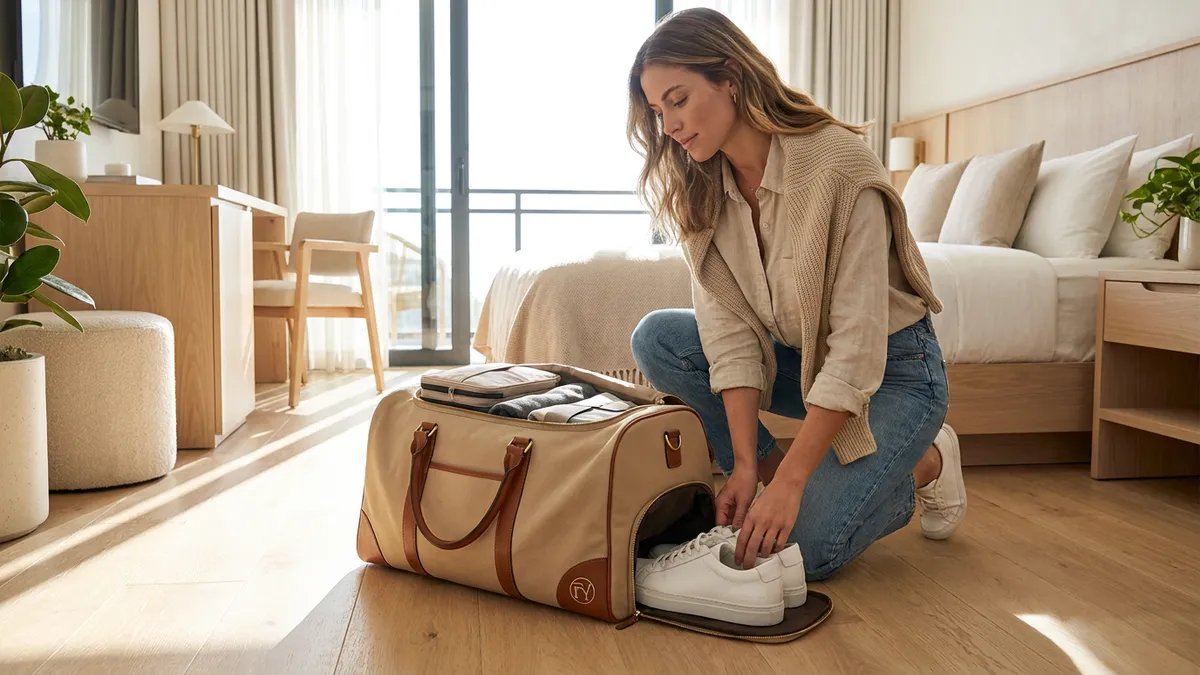
Every weekend traveler has experienced the same packing failure: shoes tossed into the main compartment of a duffle bag, sole-down on a folded blouse, leaving scuff marks and dirt on clean clothes. The “shoe problem” is universal, and it is the single most searched pain point in the weekender bag category in 2026. Analysis of product review data across Amazon, Shopify, and DTC travel brands reveals that the presence or absence of a dedicated shoe compartment is the most frequently mentioned feature in both positive and negative reviews — more than material quality, more than strap comfort, more than zipper smoothness.
For B2B buyers, this insight is actionable: a weekender bag with a properly engineered shoe compartment converts at a measurably higher rate than an identical bag without one. The feature adds approximately 2.50 to the unit manufacturing cost and enables 30 of additional perceived retail value. No other single feature in the weekender category offers a comparable return on development investment.
But “shoe compartment” is not a single design — it is a family of solutions, each with different placement, access, ventilation, and sizing characteristics. Getting the engineering right matters because a poorly designed shoe compartment (too small, no ventilation, awkward access) generates the same frustration it was supposed to solve. This guide covers the engineering options in depth, the ventilation and odor management details that most manufacturers overlook, and how to integrate the shoe compartment into a broader organized packing system that defines the modern premium weekender.
The rise of the shoe compartment as a make-or-break feature is driven by three converging factors specific to the U.S. travel market:
1. The sneaker culture crossover. American travelers — especially women under 45 — now pack sneakers or fashion trainers alongside dress shoes for short trips. A weekend getaway might require boots for a hike, white sneakers for daytime, and heels for dinner. Multiple pairs of shoes amplify the contamination problem that a single-compartment duffle cannot solve.
2. The weekend fitness routine. Gym and yoga culture means many weekend travelers pack workout shoes alongside everyday footwear. These shoes are typically worn and sweaty, making separation from clean clothes not just preferable but essential.
3. The product review feedback loop. Amazon’s review ecosystem has amplified the shoe compartment feature: early adopters praised it, generating keyword density in reviews that drove search behavior, which in turn drove more brands to offer it, generating more reviews. The feature is now self-reinforcing in the marketplace algorithm.
Percentage of reviews mentioning each feature. Based on review analysis patterns across major platforms.
The shoe compartment leads all other features by a significant margin. For B2B buyers, this data translates directly into product-page strategy: the shoe compartment should be the first feature mentioned in the bullet points, the first feature shown in the image gallery (a lifestyle shot of shoes being placed into the compartment), and the primary keyword modifier in the product title (“Weekender Bag with Shoe Compartment”).
“Shoe compartment” can be implemented in multiple ways, each with different access patterns, capacity, ventilation potential, and manufacturing complexity. Choosing the right design depends on your target consumer, bag silhouette, and price tier.
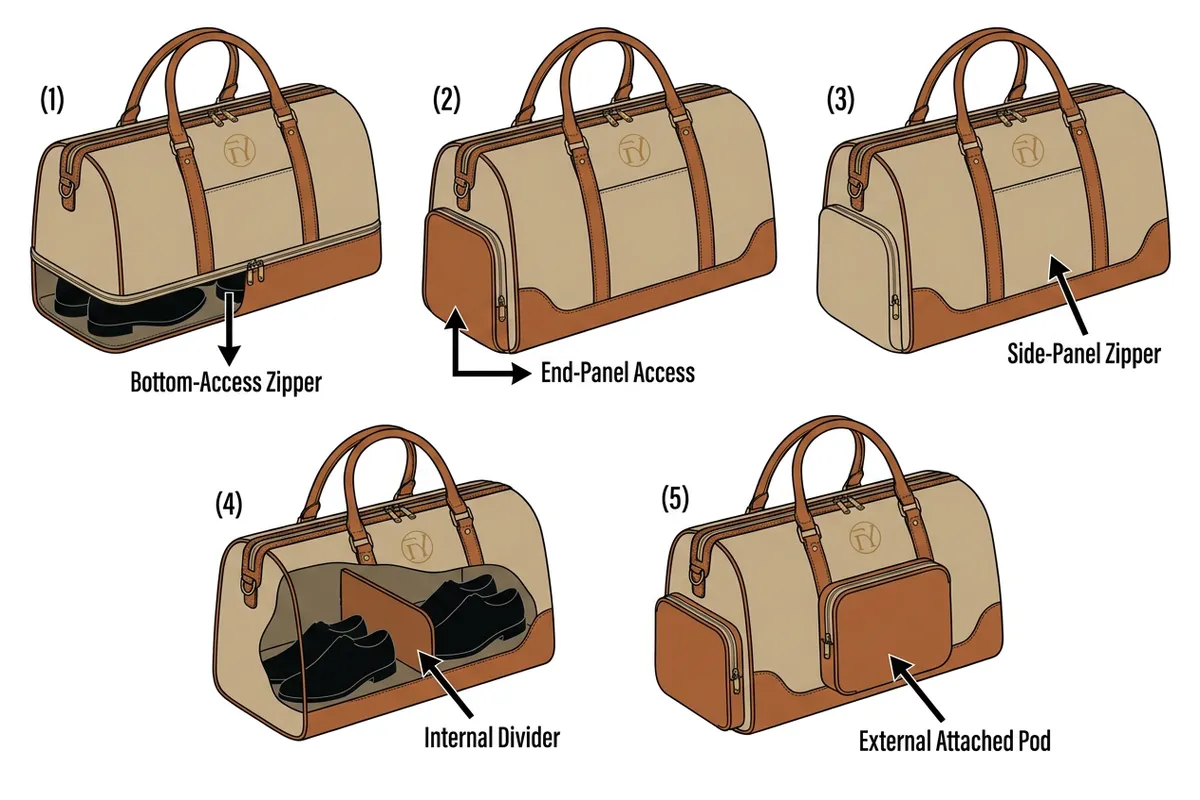
| Design | Location | Access | Shoe Capacity | Ventilation Potential | Manufacturing Complexity | Best For |
|---|---|---|---|---|---|---|
| Bottom-access | Full-width bottom layer | Horizontal zip across front base | 1 pair up to men’s 11 / women’s 12 | Good — grommets on bottom panel | Medium | Most popular; largest capacity |
| End-panel | One end of the bag, full depth | Vertical zip on end panel | 1 pair up to women’s 10 | Moderate — grommets on end | Medium | Compact weekenders; good for women’s bags |
| Side-panel | Lower portion of one side | U-shaped zip on side | 1 pair up to women’s 9 | Limited — space constrained | Medium–High | Slim-profile duffles |
| Internal divider | Inside main compartment, zippered mesh or fabric wall | Access through main opening | 1 pair (shared space) | Low — enclosed within main compartment | Low | Budget tier; not a true “separate” compartment |
| External attached pod | Clip-on or zip-on external pouch | Separate pouch access | 1 pair + flexibility to detach | Excellent — fully external | Low (pouch) + clip hardware | Modular systems; detachable = versatile |
For the U.S. women’s weekender market, the bottom-access design is the clear leader. It offers the largest shoe capacity (accommodating both women’s fashion boots and sneakers), the strongest physical separation from clothes (shoes below, everything else above), and the most intuitive access pattern (zip open the bottom, place shoes, zip closed). It also photographs well for e-commerce — the hero shot of the bottom panel unzipped with shoes visible inside is one of the most conversion-effective images in the weekender category.
The external attached pod is an emerging alternative worth watching. The shoe pouch clips to the bag’s exterior or tucks into a designated exterior pocket when not in use, and detaches entirely when the traveler does not need shoe separation. This modularity appeals to minimalist travelers and allows the base bag to serve as a standard duffle when the shoe pouch is not attached.
Most weekender bags that claim a “shoe compartment” fail on one critical dimension: ventilation. A sealed compartment containing worn shoes — even for a few hours — develops odor that transfers through fabric walls and permeates adjacent compartments. Proper ventilation is not a luxury detail; it is what separates a functional shoe compartment from an odor trap.
| Component | Specification | Why It Matters | Cost Impact |
|---|---|---|---|
| Metal grommets | 3–4 × 8 mm brass or zinc alloy eyelets on exterior panel of shoe zone | Allow airflow through the compartment; prevent pressure buildup | +0.25 total |
| Mesh panel (internal) | One wall of the shoe compartment in mesh fabric rather than solid | Promotes air circulation while maintaining physical separation | +0.30 |
| Antimicrobial lining | Silver-ion or zinc-based antimicrobial treatment on shoe compartment fabric | Inhibits bacterial growth that causes odor; defensible product-page claim | +0.80 |
| Charcoal insert pocket | Small interior pocket sized for a charcoal odor-absorbing sachet | Allows consumer to add their own odor control; shows design thoughtfulness | +0.10 |
| Waterproof barrier | TPU-coated fabric on the divider between shoe zone and main compartment | Prevents moisture from worn shoes transferring to clean clothes | +0.50 |
The minimum ventilation specification for any bag claiming a functional shoe compartment: 3 metal grommets on the exterior shoe-zone panel + waterproof barrier between shoe zone and main compartment. This two-element combination costs under $0.50 per unit and prevents the two most common complaints: odor buildup and moisture transfer.
For premium positioning, add the antimicrobial lining and charcoal insert pocket. The antimicrobial treatment enables a product-page bullet point (“antimicrobial shoe compartment lining”) that resonates strongly with U.S. consumers and differentiates from competitors offering basic unventilated pockets.
The divider between the shoe compartment and the main packing well must be waterproof or water-resistant. Without this barrier, moisture from worn shoes (sweat, rain, mud residue) wicks through the fabric divider into clean clothes. This is the failure mode that generates the most negative reviews for weekender bags with shoe compartments — the compartment exists, but it does not actually isolate.
Specify TPU-coated polyester or nylon for the divider fabric. Standard uncoated fabric is not acceptable for this application. Seam tape the divider-to-body attachment seam to prevent wicking through the stitch holes.
An undersized shoe compartment is worse than no shoe compartment — it implies the feature exists but fails to accommodate the consumer’s actual shoes, generating frustration and returns. Size the compartment for the largest shoes your target demographic is likely to pack.
| Shoe Type | U.S. Size Range | Approximate Dimensions (L × W × H per shoe) | Compartment Minimum (pair) |
|---|---|---|---|
| Fashion sneakers | 6–10 | 26 × 9 × 10 cm | 30 × 20 × 12 cm |
| Running shoes | 6–10 | 28 × 10 × 11 cm | 32 × 22 × 13 cm |
| Ankle boots | 6–10 | 25 × 10 × 18 cm (height varies) | 30 × 22 × 20 cm |
| Heels / dress shoes | 6–10 | 23 × 8 × 12 cm | 28 × 18 × 14 cm |
| Flip-flops / sandals | 6–10 | 27 × 10 × 3 cm | Fits in any compartment — minimal space |
For a women’s weekender bag using the bottom-access design:
These dimensions accommodate a pair of running shoes or fashion sneakers in U.S. sizes 6–10 comfortably. For ankle boots, the height must reach 18–20 cm, which consumes a significant portion of the bag’s total height — consider whether your target consumer regularly packs boots, or whether sneaker/heel compatibility is sufficient.
Pro tip for product pages: include a shoe-size compatibility statement in the listing. “Shoe compartment fits women’s sneakers up to U.S. size 10” gives the consumer confidence and reduces “will my shoes fit?” purchase hesitation.
The shoe compartment is the gateway feature, but the most commercially successful weekender bags in 2026 extend the organizational principle across the entire bag. Consumers who value shoe separation also value compartmentalized packing generally — and the “organized packing system” becomes the product story that justifies premium pricing.
| Zone | Location | Access | Contents | Construction |
|---|---|---|---|---|
| Zone 1: Shoe compartment | Bottom or end panel | External zip | 1 pair of shoes | Ventilated, waterproof divider, antimicrobial lining |
| Zone 2: Main packing well | Center body, above shoe zone | Top U-shaped zip (opens 3 sides) | Clothes (folded or in cubes), toiletry bag | Open well with elastic compression straps |
| Zone 3: Quick-access pocket | Front exterior panel | Zip or magnetic snap | Phone, passport, wallet, boarding pass, keys | Organized: card slot, pen loop, key clip |
| Zone 4: Wet/toiletry pocket | Interior side wall or end panel | Internal zip | Toiletry bottles, cosmetics, damp swimwear | Waterproof lining (PEVA or TPU), wipeable |
The elastic compression straps in Zone 2 are a small but impactful detail: two adjustable fabric straps across the interior of the main well that cinch down over folded clothes, keeping them flat and preventing shifting during transit. They cost 0.60 per unit and replicate the functionality of packing cubes — built directly into the bag.
| Feature | What It Is | Cost | Value to Consumer | Worth Including? |
|---|---|---|---|---|
| Trolley pass-through sleeve | Fabric sleeve on back panel for rolling suitcase handle | +1.00 | High — essential for airport travelers | Yes — near-universal expectation |
| Removable shoulder strap | Detachable padded strap, 100–130 cm adjustable | +3.00 | High — hands-free carry | Yes — standard for all tiers |
| Luggage ID window | Clear window pocket on exterior for a business card or name tag | +0.20 | Moderate — practical for frequent travelers | Yes for corporate/travel programs |
| Garment fold-out panel | Interior panel that unfolds flat for wrinkle-free shirt/dress packing | +2.00 | High for business travelers | Only for business travel positioning |
| TSA-friendly toiletry pocket | Clear, zip-close pocket sized exactly for TSA 3-1-1 liquids bag | +0.40 | Moderate — convenience detail | Yes — low cost, good product-page bullet |
Personalized weekender bags command premium pricing because they solve two problems simultaneously: identification (which bag is mine on the carousel, in the car trunk, at the hotel lobby) and emotional ownership (this bag was made for me, not mass-produced for anyone).
| Technique | Visibility from Distance | Durability Through Travel | Best Placement | Per-Unit Cost | Premium Perception |
|---|---|---|---|---|---|
| Large embroidered monogram (3–4 initials, 5–8 cm) | Excellent — visible from 3+ meters | Exceptional — thread is permanent | Center of end panel or front panel | 8.00 | Very high — “investment piece” |
| Custom leather patch + foil initials | Good — visible from 1–2 meters | Very good — leather patch is durable | Front panel or end panel | 6.00 (patch + foil combined) | Very high — brand-signature element |
| Hot foil stamped name (full name, script font) | Good — visible from 1–2 meters | Good — foil bonded under heat | Front panel | 5.00 | High — personalized, not just initialed |
| Laser-engraved leather tag (detachable) | Medium — requires closer inspection | Exceptional — engraving is permanent | Handle attachment or D-ring | 5.00 | High — subtle, reusable on other bags |
| Embroidered patch (removable, Velcro) | Medium — depends on patch size | Good — patch durable, Velcro less so | Designated front panel zone | 4.00 | Medium — swappable, customizable |
For the U.S. women’s weekender market, large embroidered monogram is the highest-converting personalization format. It is visible from distance (solving the identification problem), permanent (no peeling or fading after years of travel), and reads as a premium investment rather than a disposable decoration. The monogram is typically placed on the end panel — the surface most visible when the bag is stored upright on a shelf, in an overhead bin, or on a luggage carousel.
The custom leather patch is a strong secondary option that adds brand-identity value: the patch shape, leather color, and placement become recognizable brand signatures across the collection, while the foil initials provide the personalization.
Weekender bag demand follows two peaks: summer travel (May–July) and holiday gifting (November–December). Brands should plan production accordingly.
| Milestone | Timing | Action |
|---|---|---|
| Design finalization | October–November (prior year) | Lock silhouette, shoe compartment design, material, monogram format |
| Sample production | November–December | Proto sample → approval → revision if needed |
| Bulk order placement | January | Production order with confirmed quantities and colorways |
| Bulk production | January–March (25–40 days) | Factory production + QC |
| Inventory arrival (sea freight) | March–April | Staged in warehouse or FBA by April 1 |
| Summer selling season | May–July | Peak demand — full stock required |
| Second production cycle (if needed) | July–August | Reorder or new colorways for holiday season |
| Holiday inventory arrival | October | Staged for November–December gifting demand |
For brands using air freight instead of sea freight, the timeline compresses by approximately 3 weeks — but at significantly higher shipping cost per unit. Air freight is justified for rush orders, small test batches, or high-margin premium bags where the per-unit shipping cost is a small percentage of retail price.
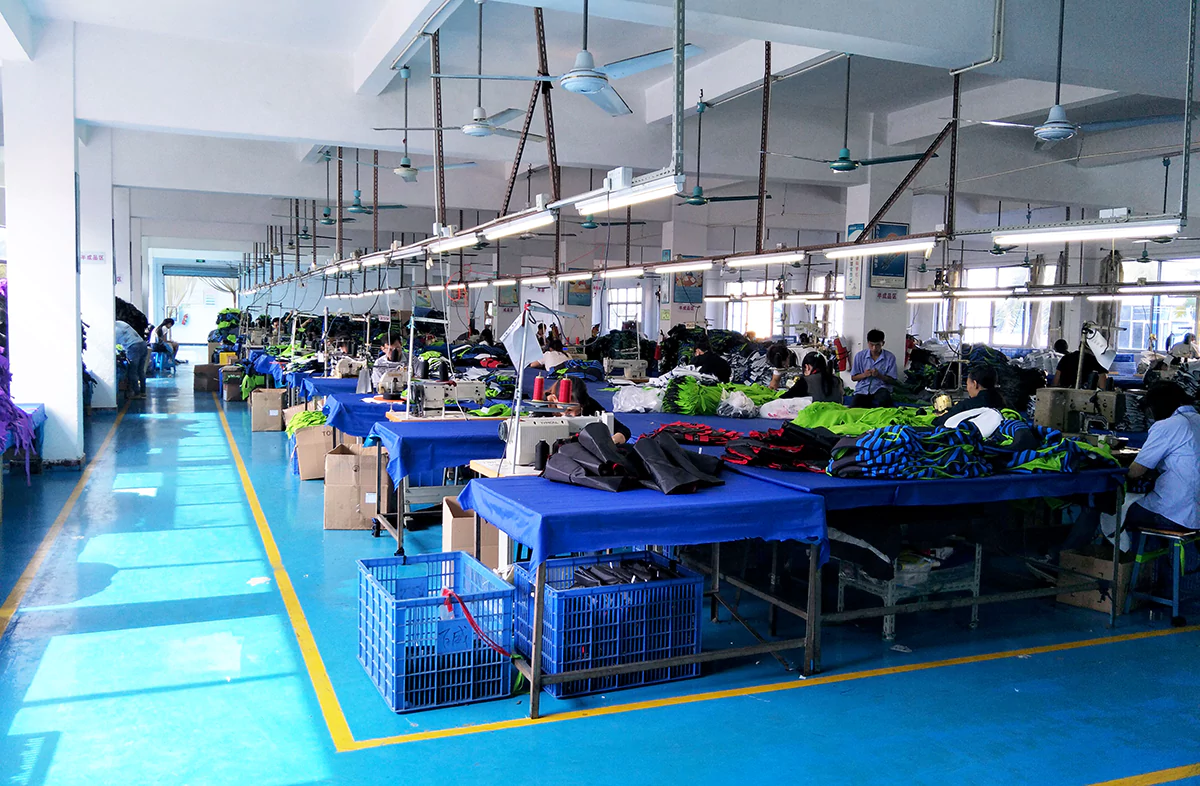
FYBagCustom is Your Trusted Custom Duffle Bag Manufacturer in China, with 15+ years of manufacturing experience producing weekender bags, travel duffles, and gym bags with organized compartment systems for brands worldwide. For buyers developing custom monogrammed weekender bags with shoe compartments, our capabilities include:
Our 50,000 m² factory in Guangzhou with 10+ production lines and 500+ professional staff produces weekender and duffle programs for DTC travel brands, Amazon FBA sellers, corporate gifting companies, retail boutiques, and lifestyle brands across international markets.
In the crowded weekender bag market, the shoe compartment has emerged as the single most influential purchase-decision feature — mentioned in more product reviews than any other attribute. For B2B buyers developing weekender bags in 2026, three core takeaways:
If your 2026 travel bag line includes weekenders with shoe compartments, now is the time to finalize compartment architecture, ventilation specifications, and monogram formats. Contact FYBagCustom to discuss design options, request ventilated shoe-compartment samples, and receive transparent quotations — typically within 48 hours.
FYBagCustom’s OEM and ODM team works with travel brands, DTC founders, Amazon sellers, and corporate gifting programs to produce custom weekender bags with ventilated shoe compartments, organized packing systems, and personalized monograms — with low MOQ, 5–7 day sampling, and 15+ years of duffle bag expertise.
Start Your Custom Bag Project →